Size, shape, density, and atmospheric limit of (50000) Quaoar revealed from 14 years of stellar occultation

Size, shape, density, and atmospheric limit of (50000) Quaoar revealed from 14 years of stellar occultation
Giuliano Margoti, Felipe Braga-Ribas, José Luis Ortiz, Bruno Sicardy, Josselin Desmars, B. E. Morgado, Eros de Oliveira Gradovski, Chrystian Luciano Pereira, Pablo Santos-Sanz, Altair Ramos Gomes-Júnior, Julio Ignacio Bueno de Camargo, Marcelo Assafin, Vieira-Martins Roberto, Yucel Kilic, Damya Souami, René Duffard, Gustavo Benedetti-Rossi, Tiago Pinheiro, Maísa Poiani, Eduardo Rondón, Marcelo Emilio, Dave Herald, Rafael Sfair, Nicolas Morales, Francois Colas, Frédéric Vachier, Mónica Vara Lubiano, Rodrigo Boufleur, Mert Acar, Francisco J. Aceituno, Miguel R. Alarcon, Sinan Alis, Sergio Alonso, Javier Alonso-Santiago, Flavia Amadio, Laerte Andrade, Pascal André, Jonatã Arcas-Silva, Alper K. Ateş, David Lafuente Aznar, Michael Backes, Mehmed Naim Bagiran, Nelson Balcar, M. A. Barry, Khalid Barkaoui, Wolfgang Beisker, Kirk Bender, Zouhair Benkhaldoun, Svetlana Boeva, Eberhard H. R. Bredner, Richard Busuttil, A. ~Y. ~Burdanov, Oscar Canales, Javier Zaragoza-Cardiel, V. Casanova, Matheus Leal Castanheira, Peter Ceravolo, Steven J. Conard, Luciano Negrello Correa, Daniel V. Cotton, V. S. Dhillon, Serena Diamond, Vlad Dumitrescu, Joan Dunham, David W. Dunham, Christopher L. Duston, Eslam Elhosseiny, Orhan Erece, Sila Eryilmaz, Emilio J. Fernandez-García, Suleyman Fisek, R. Scott Fisher, Clyde Foster, Eric Frappa, Antonio Frasca, Jonah Frey, José María Gómez-Limón Gallard, Jose Luis Maestre Garcia, Dave Gault, Kosmas Gazeas, Kai Getrost, Michael Gillon, Alan Gilmore, Robert Glassey, K. D. Green, William Hanna, Nicholas J. Haigh, Dean Hooper, Kamil Hornoch, Dragana Ilic, Cristóvão Jacques, Felix~Jankowsky, Emmanuel Jehin, Selami Kalkan, Roxanne Kamin, Monika K. Kamińska, Shai Kaspi, J. J. Kavelaars, Stephen Kerr, Ulrich Kolb, Richard Komvzik, Dogan T. Koseoglu, Mike Kretlow, Sangeeta Kuchibhotla, Jean Lecacheux, Arnaud Leroy, Alexios Liakos, Luana Liberato, Peter Lindner, S. P. Littlefair, Jose M. Madiedo, Natalio Maícas, Marcio Malacarne, Paul Maley, Jan Mánek, Anna Marciniak, Patrick Martinez, Ramón Iglesias-Marzoa, Graeme McKay, Steve Messner, Zdeněk Moravec, Eduardo Fonseca Morato, Messias Fidêncio Neto, John Newman, Vadim Nikitin, Richard Nolthenius, Peter Nosworthy, Mohammad Odeh, W. Ogloza, Sibel Otken, Sacit Özdemir, Andras Pal, Ashley Pennell, Amauri Pereira, Carles Perello, Jean Perkins, Konstantin von Poschinger, Thiago do Prado, Theodor Pribulla, Sohrab Rahvar, Giovana Ramon, Seth Redfield, Claudine Rinner, Jean-Pierre Rivet, Johannes Antunes Nascimento Ro, rigues Antonio Román-Reche, Flavia Luane Rommel, T. de Santana, T. Santana-Ros, Antoni Selva, Christoph M. Schaefer, Andrew Scheck, Carles Schnabel, Olivier Schreurs, Andreas Schweizer, M. Serra-Ricart, Ned Smith, Colin Snodgrass, Eda Sonbas, A. Sota, Rafael Ribeiro de Sousa, Fabio Augusto Spina, Theodore Swift, Robert Szakats, Ali Takey, Mohammad F. Talafha, Ramachrisna Teixeira, Zahide Terzioğlu, Qiushi Chris Tian, Vagelis Tsamis, Eyüp Kaan Ülgen, Oliver Vince, Marcos Rincon Voelzke, Christian Weber, Julien de Wit, Michal Zejmo
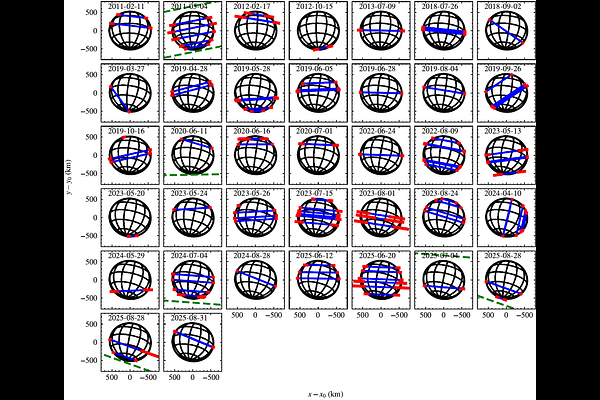
AbstractWe present results from 28 stellar occultations by the large Trans-Neptunian Object (50000) Quaoar registered between 2018 and 2025. By performing a joint analysis of this occultation data-set, along with other 9 published events, we were able to fit an oblate ellipsoid shape, with equatorial semi-axes, a and b of 566.1+2.5-2.2 km, and a polar semi-axis, c, of 511.2+3.6-3.7 km. It provides an equivalent volumetric diameter of 1094.4 +/- 4.6 km and polar oblateness of 0.097 +/- 0.011. Considering an absolute magnitude of H = 2.79 +/- 0.35, we derive a geometric albedo of pV = 0.125 +/- 0.038. We have derived new upper limits to the surface pressure of a CH4 atmosphere of 0.15 nbar (1-sigma) and 0.65 nbar (3-sigma). We also provide a table with the 36 new astrometric positions for Quaoar. Using the new system mass derived from Weywot's orbit around Quaoar, we calculated a density of 1.760 +/- 0.109 g/cm3. Moreover, from the derived size and rotation period (8.8394 +/- 0.0002 hours (Ortiz et al. 2003)), we calculate that, if Quaoar is in Maclaurin hydrostatic equilibrium state, it would have a density of 1.859 +/- 0.200 g/cm3. This result, within the error bars, is compatible with the value we found. Therefore, this work shows that Quaoar can be a Maclaurin object, being eligible as a dwarf planet.