Too Big to Quench? I. Constraining ISM Stripping of Dwarf Satellites in Milky Way-like Halos

Too Big to Quench? I. Constraining ISM Stripping of Dwarf Satellites in Milky Way-like Halos
Jingyao Zhu, Stephanie Tonnesen, Greg L. Bryan, Mary E. Putman
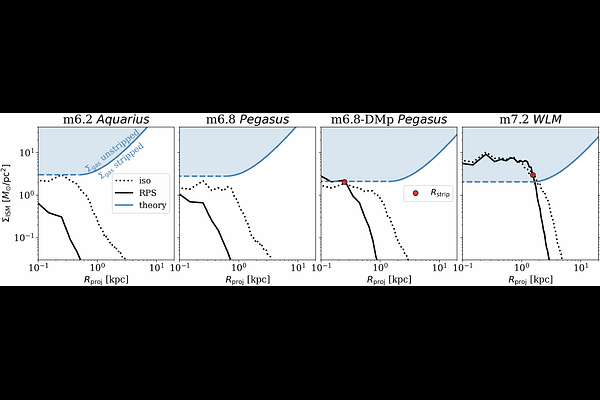
AbstractGalaxy environment plays a crucial role in quenching star formation in dwarf galaxies. In Milky Way (MW)-like environments, dwarf satellite quenching is primarily driven by ram pressure stripping (RPS), the direct removal of satellite gas by the host halo gas. Using a suite of 20-pc resolution hydrodynamical wind tunnel simulations, we constrain the satellite mass scale at which the stripping of a dwarf galaxy's interstellar medium (ISM) becomes inefficient in MW-like halos. The simulations include radiative cooling in a multiphase satellite ISM, star formation, and stellar feedback, and vary both satellite masses ($M_{\star}=10^{6.2}, 10^{6.8}, 10^{7.2}\ M_{\odot}$) and host halo gas densities along a first-infall and post-pericentric orbit. We find that the degree of ISM stripping in our dwarf galaxies is consistent with the analytical prediction by McCarthy et al. (2008). Star formation is rapidly quenched when RPS is effective, but can be mildly enhanced or temporarily quenched and subsequently reignited when RPS is incomplete. ISM stripping is efficient for satellites with $M_{\star} \lesssim 10^{7}\ M_{\odot}$ (or $M_{200} \lesssim 10^{10}\ M_{\odot}$) but highly inefficient above this scale. This transitional mass ($M_{\star} \approx 10^{7}\ M_{\odot}$) is 0.5-1 dex lower than that found in observations and cosmological simulations, suggesting that additional mechanisms are needed to quench more massive satellites, such as tidal stripping of the satellite dark matter or RPS from a clumpy gaseous halo.