A Homogeneous Catalog of Rossiter-McLaughlin Systems: Distinct $e$-$λ$ Trends in Three Gas-Giant Mass Regimes

A Homogeneous Catalog of Rossiter-McLaughlin Systems: Distinct $e$-$λ$ Trends in Three Gas-Giant Mass Regimes
Xian-Yu Wang, Songhu Wang, Konstantin Batygin
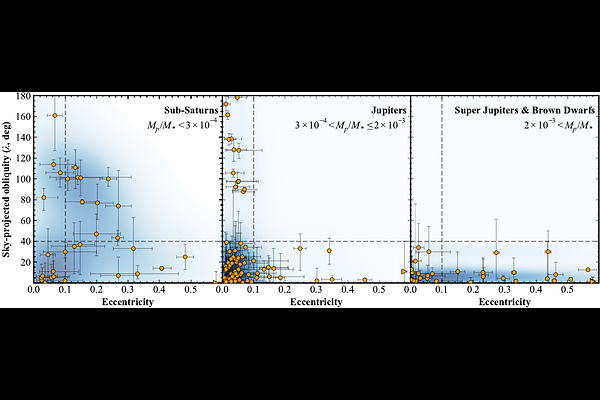
AbstractStellar obliquity ($λ$) and orbital eccentricity ($e$) trace the dynamical histories of close-in giant planets, but the current observational picture is assembled from heterogeneous analyses that have obscured population-level trends. In this work, we homogeneously refit systems with Rossiter-McLaughlin (RM) measurements by performing a joint global fit to spectral energy distributions, transit light curves, mid-transit times, out-of-transit and in-transit radial velocities, yielding self-consistent posterior distributions for the physical and orbital parameters of both stars and planets across 255 systems. Restricting to 145 single-star systems with reliable planet-mass measurements, we uncover pronounced structure in the $e-λ$ plane that depends on planet mass: (i) sub-Saturns ($M_{\rm p} \leq \sim0.3M_{\rm J}$) can be both eccentric and misaligned; (ii) Jupiters ($\sim0.3M_{\rm J}<M_{\rm p} \leq \sim3 M_{\rm J}$) are misaligned only on circular orbits; and (iii) super Jupiters and brown dwarfs ($M_{\rm p}>\sim3M_{\rm J}$) are aligned across the full eccentricity range. A two-dimensional Kolmogorov-Smirnov test shows that the joint $(e,λ)$ distributions differ significantly among these three mass regimes. These trends demonstrate that $λ$ depends jointly on eccentricity and planet mass, implying that obliquity alone is not a unique tracer of evolutionary history and underscoring the need for a unified framework for the origins of spin-orbit misalignment. The full catalog from this work is publicly available at https://www.stellarobliquity.com .