Intracellular Mechanosensation in Intestinal Smooth Muscle: Piezo1 Complexes Amplify Signaling Beyond the Surface

Intracellular Mechanosensation in Intestinal Smooth Muscle: Piezo1 Complexes Amplify Signaling Beyond the Surface
Bautista, G. M.; Manning, D.; Lieu, E. C.; Matsumoto, C.; Ugochukwu, S.; Tulman, J. P.; Aragon Baudel, M. M.; Rubio, N. D.; McElroy, S. J.; Baker, S.; Navedo, M. F.; Santana, L. F.
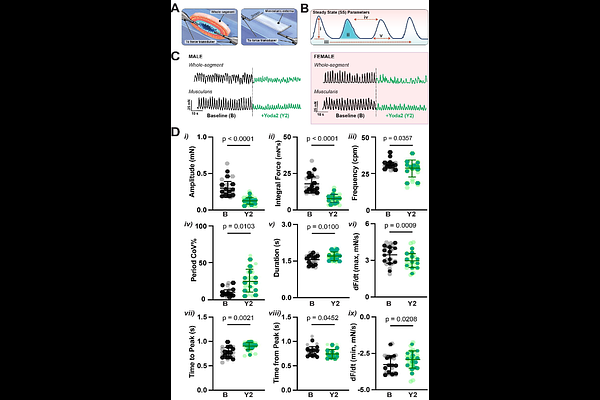
AbstractMechanosensation is fundamentally viewed as a plasma membrane phenomenon. We challenge this paradigm by introducing intracellular mechanosensation in intestinal smooth muscle. We hypothesized that a distinct, organelle-based signaling axis exists to amplify mechanotransduction from the inside out. To test this, we investigated whether Piezo1, a canonical plasma membrane mechanosensor, also operates within the cell. Using tissue-level wire myography, high-resolution confocal microscopy, proximity ligation assays, and patch-clamp electrophysiology on freshly dissociated cells, we identified a functional intracellular signaling hub that starts at the sarcoplasmic reticulum (SR). Unlike surface transduction, this intracellular mechanism relies on a nanoscale multiprotein complex (less than 40 nm) comprising an SR sensor (intra-Piezo1) and an amplifier (Ryanodine Receptor, RyR), coupled with a PM effector (large-conductance, Ca2+-activated K+ channels, i.e., BKCa channels). Activating this intracellular complex generated massive BK-mediated outward currents independent of extracellular Ca2+ but strictly dependent on internal SR Ca2+ stores, confirming intrinsic organellar mechanotransduction. Within this complex, intra-Piezo1 and RyR are positioned to operate as a coupled SR Ca2+ release unit that activates BK channels at SR, PM junctions, driving potent membrane hyperpolarization that reduces smooth muscle contractility, revealing the intra-Piezo1 complex as a molecular brake on excitation. These findings demonstrate that mechanotransduction is not confined to the cell surface. Instead, a specialized Sensor, Amplifier, Effector complex originating at intracellular organelles amplifies cellular sensitivity to physical force, providing a critical gain-control system that restrains smooth muscle excitability and regulates GI motility.