Drift-driven microbiome simplification generates reconstructable and ecologically cohesive microbial communities

Drift-driven microbiome simplification generates reconstructable and ecologically cohesive microbial communities
Chaboy-Cansado, R.; Cobeta, P.; Gallego, R.; Rastrojo, A.; Aguirre de Carcer, D.
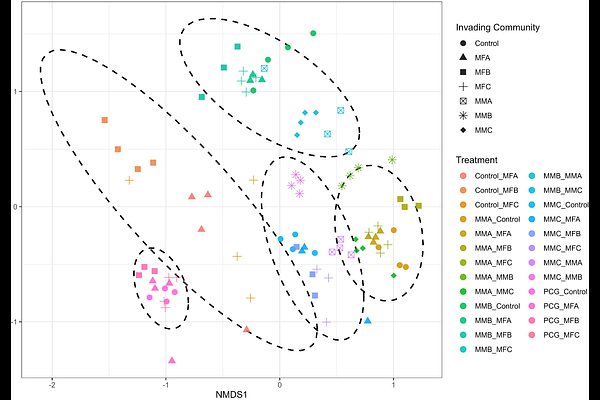
AbstractEngineering simplified microbial communities that retain function and ecological cohesiveness remains a major challenge because the taxa and interactions required for community establishment are rarely known a priori. Here, we experimentally evaluated drift-driven microbiome simplification as an alternative strategy for generating reduced and reconstructable microbial consortia. Using the tomato rhizosphere as a model system, three source microbial communities were subjected to different dilution bottlenecks and serial propagation. Increasing dilution was the main determinant of community composition and simplification, while repeated passage produced additional reductions in ASV richness, phylogenetic diversity, and evenness. Importantly, diversity loss was not accompanied by a uniform deterioration in bacterial colonization or plant performance, indicating that substantial simplification can occur without a parallel collapse in these system-level properties. Candidate Minimal Microbiome prototypes were selected from endpoint communities, reconstructed as synthetic communities, and their ecological cohesiveness was evaluated through invasion experiments. The reconstructed communities strongly restricted the establishment of the original complex microbial fractions, although invasion success depended markedly on invader identity. The drift-derived communities were at least as resistant to invasion as an independently designed bottom-up synthetic community. Together, these results provide experimental support for drift-driven simplification as a strategy to generate reduced microbial communities whose dominant members can be isolated, reconstructed, and experimentally evaluated. By allowing ecological assembly to generate candidate community configurations before cultivation and reconstruction, this approach provides a complementary route to rational bottom-up design and function-directed top-down microbiome engineering.