Photometric Variability and Rotation of Beta Pictoris b from JWST NIRCam Coronagraphic Imaging

Photometric Variability and Rotation of Beta Pictoris b from JWST NIRCam Coronagraphic Imaging
Yifan Zhou, Beth A. Biller, Aarynn L. Carter, Marshall D. Perrin, Michael Poon, Genaro Suárez, Ben J. Sutlieff, Johanna M. Vos, Jason J. Wang, William O. Balmer, Marta L. Bryan, Anthony Boccaletti, Julien H. Girard, Eileen C. Gonzales, Jens Kammerer, Jarron M. Leisenring, Paulina Palma-Bifani, Kevin R. Wagner, Daniel Apai, Mickaël Bonnefoy, Brendan P. Bowler, Kyle Franson, Pengyu Liu, Marcio Meléndez, Stanimir A. Metchev, Simon Petrus, Laurent Pueyo, Isabel Rebollido, Andrew J. Skemer, Xianyu Tan, Niall Whiteford
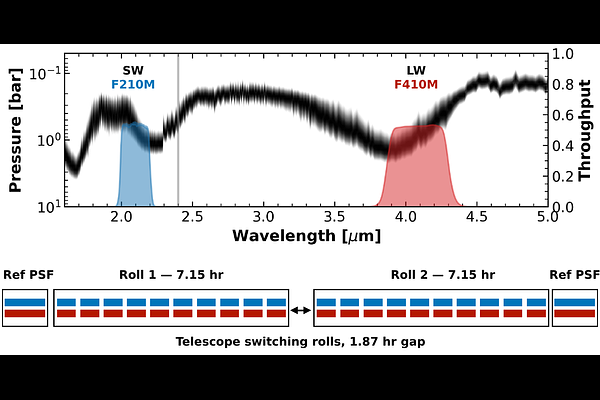
AbstractWe report the detection of photometric variability in the directly imaged super-Jupiter $β$ Pictoris b. Using JWST NIRCam dual-band coronagraphic imaging, we conducted a 16-hour continuous photometric monitoring campaign in the F210M and F410M filters. We developed and validated a time-series photometry framework that combines PSF subtraction, principal component analysis for systematic noise removal, and injection-and-recovery tests to confirm signal fidelity. Both light curves show consistent sinusoidal variability at $\sim$5$σ$ and $\gg 5σ$ significance in the F210M and F410M bands, respectively. A joint sinusoidal fit yields a rotation period of $P_{\rm rot} = 9.00 \pm 0.13$ hr and variability amplitudes of $0.85 \pm 0.07\%$ and $0.89 \pm 0.04\%$ in F210M and F410M, respectively. The near-identical amplitudes and periods in both bands confirm a common astrophysical origin in a heterogeneous atmosphere. Combining $P_{\rm rot}$ with the previously measured projected rotational velocity, we constrain the line-of-sight spin axis inclination of $β$ Pic b. The result favors an equator-on viewing geometry, consistent with line-of-sight spin-orbit alignment: the planetary spin axis, orbital plane, debris disk, and stellar equator are all mutually aligned. This stands in sharp contrast to the large obliquities of wide-separation companions that are likely formed via gravitational fragmentation. Together with the system's young age, this observation provides independent dynamical evidence that $β$ Pic b formed via core accretion. This result constitutes the first detection of rotational modulation in a close-in, high-contrast exoplanet that likely formed via core accretion, demonstrating that time-series coronagraphic imaging with JWST opens a powerful new window onto the rotation, atmospheric dynamics, and spin-orbit architecture of this population.