Surface Functionalized RBC Membrane-Derived Nanoparticles for Targeted Drug Delivery to Attenuate Fatty Liver Disease

Surface Functionalized RBC Membrane-Derived Nanoparticles for Targeted Drug Delivery to Attenuate Fatty Liver Disease
Zahid, A. A.; Huang, J.; Borradaile, N.; Paul, A.
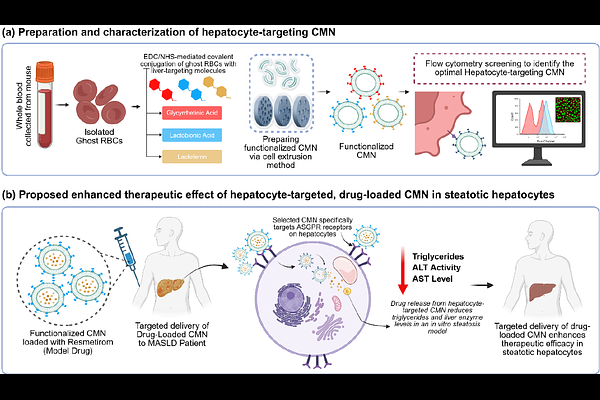
AbstractMetabolic dysfunction-associated steatotic liver disease (MASLD) is marked by excessive hepatic lipid accumulation and is closely associated with hyperlipidemia. It poses significant health challenges and can progress to severe chronic liver disease if untreated. Several small-molecule pharmacological agents are either in clinical use (resmetirom) or advancing through preclinical development for the treatment of hepatic steatosis. However, some promising lead drug candidates have limited therapeutic potential due to poor solubility, low permeability, limited biocompatibility, and off-target effects. Cell membrane-derived nanoparticles (CMN), prepared from red blood cells, naturally exhibit immune-evasion properties and can overcome these limitations by encapsulating small molecules within their self-assembled structures. Further, CMN can be surface functionalized to enable precise targeting of liver hepatocytes. Here, we developed a hepatocyte-targeting CMN loaded with a model drug (resmetirom) for MASLD therapy. Using covalent bonds, we conjugated three different hepatocyte-targeting ligands to CMN and identified lactoferrin as the most effective ligand through comparative screening. We then confirmed the cellular internalization pathways of the selected ligand in both targeted CMN and non-functionalized CMN. Finally, in an in vitro hepatic steatosis model, the optimized targeted CMN demonstrated improved bioactivity, including significant reductions in lipid droplets, triglycerides, and liver enzyme levels. Altogether, this targeted CMN platform shows promising potential to enhance the therapeutic efficacy of small-molecule drugs for MASLD and may, overall, improve therapeutic outcomes in preclinical and clinical trials.