Active Galactic Nucleus Feedback in an Elliptical Galaxy. IV. The Importance of the Jet Wind Coupling

Active Galactic Nucleus Feedback in an Elliptical Galaxy. IV. The Importance of the Jet Wind Coupling
Minhang Guo, Feng Yuan, Suoqing Ji, Bocheng Zhu
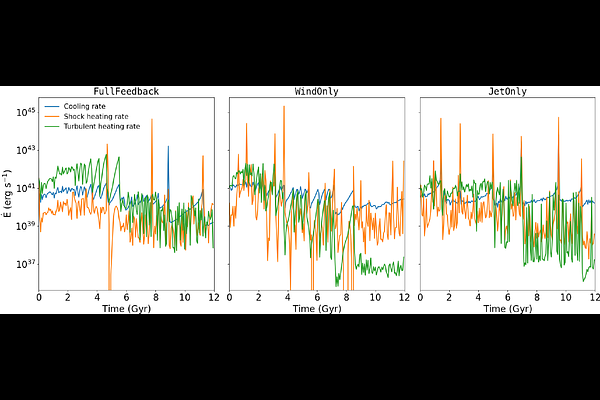
AbstractThis is the fourth paper of our series investigating the effects of active galactic nucleus (AGN) feedback in the evolution of an elliptical galaxy using the {\it MACER} framework. While previous works considered only AGN radiation and wind, we now add jet feedback. The values of the jet parameters are taken from small-scale general relativity MHD simulations of black hole accretion. We run three models: {\tt FullFeedback}, {\tt JetOnly}, and {\tt WindOnly}. Time-averaged star formation rates are $10^{-1}$, $10^{-2}$, and $10^{-3} \mathrm{M}_\odot\,\mathrm{yr}^{-1}$ in {\tt JetOnly}, {\tt WindOnly}, and {\tt FullFeedback}, respectively. Despite the higher jet power, jet feedback is less efficient than wind due to a small opening angle and low momentum flux. The much lower star formation rate in {\tt FullFeedback} indicates nonlinear coupling between jet and wind, with stronger suppression than the linear sum. The AGN energy dissipation efficiency values (fraction of injected kinetic energy dissipated via turbulence and shock) are 0.64 ({\tt FullFeedback}), 0.48 ({\tt WindOnly}), and 0.26 ({\tt JetOnly}). In the {\tt FullFeedback} model the wind-jet shear results in Kelvin-Helmholtz instability, driving stronger turbulence that effectively converts AGN kinetic energy into heating.