Is the Dark Comet 1998 KY$_{26}$ the Spacecraft Phobos 1?

Is the Dark Comet 1998 KY$_{26}$ the Spacecraft Phobos 1?
Adam Hibberd, Adam Crowl, Carlos Gómez de Olea Ballester, Abraham Loeb
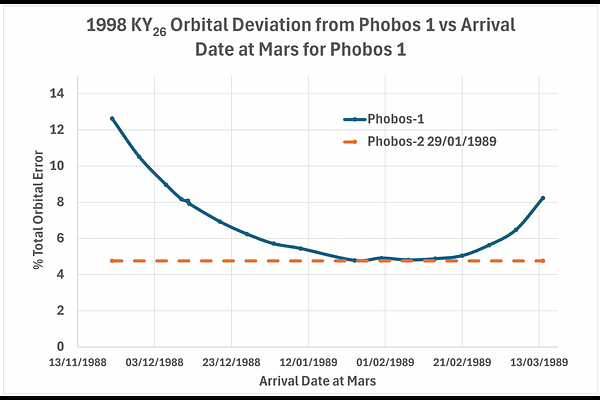
AbstractSince the discovery of new kinds of celestial bodies known as $dark~comets$, scientists have speculated about their ontology. A curious hybrid of comet and asteroid, these objects show significant non-gravitational accelerations (NGAs) yet exhibit absolutely no signs of cometary outgassing in the form of a coma or tail. The planned rendezvous of the Hayabusa2 spacecraft with 1998 KY$_{26}$ in July 2031 elevates the question of this so-called dark comet's nature beyond a purely research exercise, as the true nature of the object may have practical implications for the scientific return of the mission. This study examines the hypothesis that 1998 KY$_{26}$ may be of technogenic origin, in fact a relic of a historical Russian mission to Mars, the Phobos 1 probe, which suffered a failure 2 months after the launch in July 1988, due to upload of a faulty command. We find that two propulsive DeltaVs combined at 1.9 km/s, the first just after loss of mission and the second in May 1996, allow the orbits and phases of the two bodies to align, with an arbitrarily low $Mahalanobis~distance$ using the covariance of the dark comet in 6D phase space. There is also evidence that 1.9 km/s was within the performance envelope of Phobos 1, which had a powerful nitric acid and amine-based autonomous thruster for Mars Orbital Insertion (MOI).