Mapping Cosmological Signal Scales to Beam Calibration Requirements in 21cm Experiments and Implications for Near-Field Measurement

Mapping Cosmological Signal Scales to Beam Calibration Requirements in 21cm Experiments and Implications for Near-Field Measurement
Daniel C. Jacobs
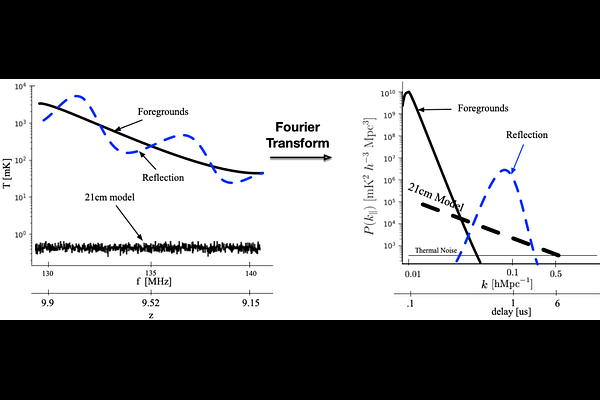
AbstractInstruments targeting 21~cm emission at high redshifts need a spectral dynamic range of better than ten thousand to distinguish the 21~cm background against bright foregrounds. Systematics arising from the antenna pattern are a leading limitation for current instruments and must be addressed in future experiments. Antenna pattern measurements could help reach this precision. Pattern measurements are complicated by the large scale of the instruments and interaction with the local environment. In-situ beam mapping methods have been investigated but the required accuracy remains ill defined. One consideration is whether the calibration source is in the far field. Near field measurements require more elaborate measurement and such an expense must be well motivated. The far field distance is set by the effective size of the antenna. Reflections and interactions with surroundings extend the effective size of the antenna to scales well beyond the physical aperture. Here we give a new, instrument-agnostic method for calculating beam calibration requirements. Using 21cm models and instrument noise we prescribe bounds on the geometric reflection size scales. These scales must be shown via measurement to be below noise. This prescription depends weakly on instrument-specific noise and for interferometers, on the characteristic baseline length, but is otherwise independent of any detailed simulation of antenna or analysis pipeline. Example calculations for HERA-like and EDGES-like instruments find cosmological structures map to reflection scales of 100~m. This far field distance puts ground-based transmitters close to the horizon and drone sources well above typical or legal operating heights. A near-field measurement approach is necessary. Phase-locked systems have been demonstrated with promising results but more work is necessary to validate an antenna pattern at the necessary dynamic range.