Disentangling the Morphology of Palomar~5: Effects of the Bar, Spiral Arms, LMC, and Halo Flattening

Disentangling the Morphology of Palomar~5: Effects of the Bar, Spiral Arms, LMC, and Halo Flattening
Zhenghao He, Long Wang, Zi-yi Zhou, Yang Huang, Eugene Vasiliev
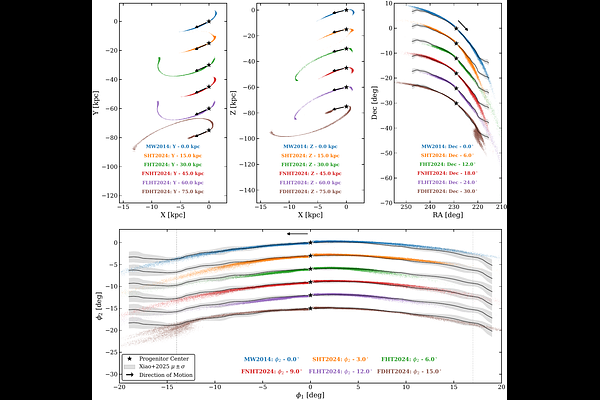
AbstractThe Palomar~5 (Pal~5) globular cluster and its tidal tails provide a sensitive probe of globular-cluster evolution in the time-dependent Milky Way potential. We study the past 3~Gyr evolution of Pal~5 using collisional direct \(N\)-body simulations with \texttt{PeTar}, adopting Galactic potential models that include spiral arms, the Galactic bar, halo flattening, the Large Magellanic Cloud (LMC), and bar deceleration. We find that halo shape strongly influences the projected stream track, reflecting Pal~5's sensitivity to Galactic force-field flattening. The LMC causes only modest direct changes to the present-day projected stream morphology, but can alter the pericentric distance and hence the progenitor's mass evolution. The Galactic bar strongly affects stream length and debris redistribution along the tails, producing model-dependent density structures and leading--trailing asymmetries. Comparison with observations from Erkal et al. (2017) and Xiao et al. (2025) shows that no single model simultaneously reproduces all observed properties of Pal~5, including cluster evolution, stream length, track, width, and line-density profile. Although our simulations capture several global properties, the remaining discrepancies indicate that a more precise match likely requires better constraints on the initial properties of the Pal~5 progenitor and a more complex Galactic potential, including perturbations from small-scale perturbers such as dark matter subhalos and giant molecular clouds. Future work may combine self-consistent direct \(N\)-body simulations with particle-spray methods to investigate these discrepancies more efficiently.