Competition between co-localized gut symbionts underlies inter-individual variation in the honeybee gut microbiota

Competition between co-localized gut symbionts underlies inter-individual variation in the honeybee gut microbiota
Santos-Matos, G.; Benedetti, J.; Ndiaye, M.; Pocuca, J.; Pignon, E.; Negi, S.; Miyazaki, R.; Schaerli, Y.; Marin Arancibia, M.; Engel, P.
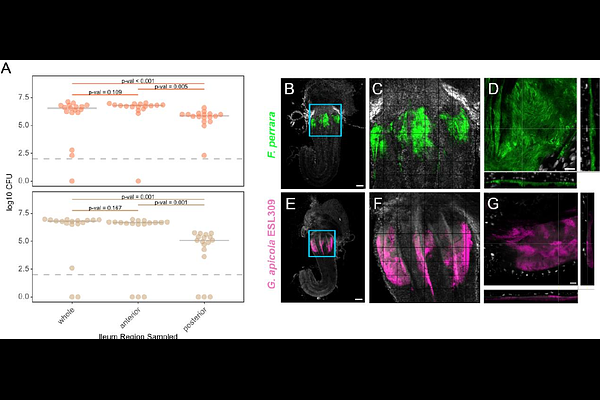
AbstractMicrobes in the animal gut compete to colonize spatially restricted host niches. However, whether competition for space drives inter-individual variation among hosts, and which factors determine the outcome of such competition, remain poorly understood. Here, we investigated competitive interactions of the western honeybee gut symbiont Frischella perrara with other members of the bee gut microbiota. Shotgun metagenomics analysis of individual bees revealed that F. perrara is negatively correlated with a specific species of the genus Gilliamella. Co-colonization of microbiota-depleted bees with these two bacteria resulted in their competitive exclusion. The outcome of this competition depended on the relative number of bacteria each bee received and benefited Gilliamella when one of the two type VI secretion systems of F. perrara was mutated. Using fluorescently tagged strains, high-resolution microscopy, and gut region-specific quantification, we show that both bacteria localize to the same host niche in the ileum of mono-colonized bees, indicating competition in a spatially restricted host niche. Moreover, both microbes protected against infection, promoting bee health. This competition provides an explanatory mechanism underlying variation in the occurrence of F. perrara across honeybee colonies and highlights the importance of gut spatial structure and microbial competition in shaping microbiome composition and inter-individual variability.