Proteomic mapping of the dengue virus NS1 microenvironment in infected cells identifies novel host dependency factors including TM9SF3

Proteomic mapping of the dengue virus NS1 microenvironment in infected cells identifies novel host dependency factors including TM9SF3
Centofanti, S. M.; Colella, A.; Chegeni, N.; Aliakbari, K.; Bracho, G.; Hesping, E.; Roche, M.; Carr, J. M.; Chataway, T.; Eyre, N. S.
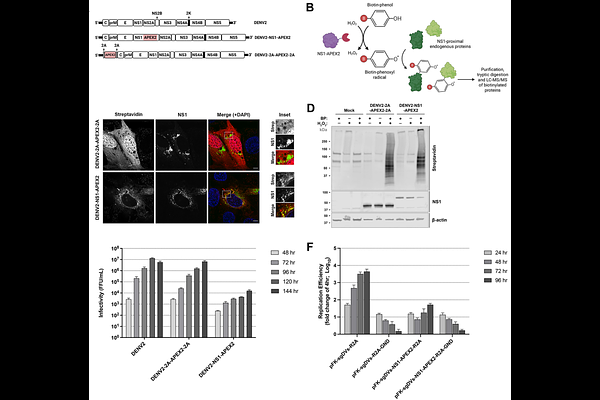
AbstractDengue virus (DENV) is endemic in over 100 countries and causes approximately 100 million symptomatic infections annually, with symptoms ranging from mild febrile illness to life-threatening severe vascular leakage and haemorrhagic fever. There are currently no approved antiviral therapies available to treat DENV infections. The DENV non-structural protein 1 (NS1) is essential for viral RNA replication and infectious virus particle production, while secreted NS1 contributes to immune evasion and pathogenicity. Towards the identification of novel NS1-host protein interactions that are critical to these functions, an APEX2 proximity labelling-coupled quantitative proteomics approach was employed to map the proteomic composition of the NS1 microenvironment in live infected cells. Our analysis identified a panel of 51 NS1-proximal host proteins, including established DENV host dependency factors (HDFs) involved in NS1 folding and N-glycosylation, as well as previously unrecognised host factors. Loss-of-function approaches were used to determine the importance of these NS1-proximal host proteins to DENV infection, identifying several novel HDFs, including transmembrane 9 superfamily member 3 (TM9SF3). Importantly, the knockout of TM9SF3 was shown to impair DENV infectious virion production and intracellular NS1 abundance and secretion, consistent with the recently described roles of TM9SF3 in Golgi integrity and glycosylation fidelity. Together, this study demonstrates the successful application of APEX2 proximity labelling-coupled quantitative proteomics to the identification of functionally relevant NS1-associated host proteins that may inform the development of future antiviral therapies.