WorldKernel: A World Model is the Coupling Kernel of Admissible Possible Worlds

WorldKernel: A World Model is the Coupling Kernel of Admissible Possible Worlds
Fabio Rovai
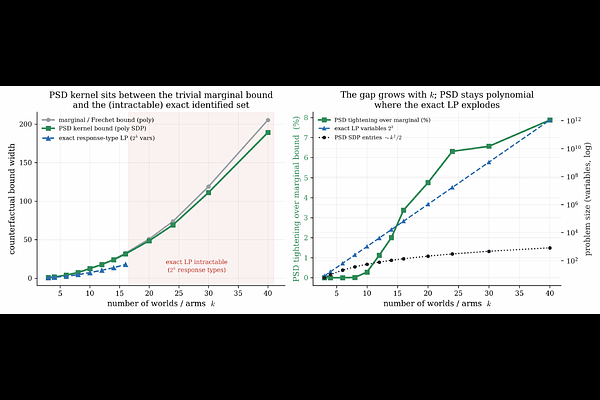
AbstractA common assumption holds that enough observational and interventional data, given to a strong enough predictor, suffices. We report a failure mode that contradicts it. Across hundreds of structural causal models, on identified quantities a strong predictor and a Bayesian baseline both succeed, but on unidentified quantities (the couplings between counterfactual worlds) the predictor collapses to a point, on 28% of models to one no valid model can produce, while the truth is an admissible interval more data never narrows. The gap is structural: prediction cannot represent uncertainty over counterfactual couplings. We cast a world model as a single positive semidefinite coupling kernel K(T,T') over admissible worlds, whose diagonal is the ordinary posterior (what a predictor recovers) and whose off-diagonal is the cross-world coupling it cannot, which every counterfactual reads. The paper is the theory of that off-diagonal. It is real: two states with identical posteriors differ on a cross-world query, and the off-diagonal is the coupling that fixes counterfactuals. It can be bounded: positive semidefiniteness is partial-identifying information the marginals lack, and enforcing it bounds counterfactuals in polynomial time where the exact response-type program is intractable. Logical structure sharpens it: ontology axioms tighten the bound by up to a third, propagating to couplings they never touch. It can be acquired: targeted scars, constraints learned from encountered infeasibilities, close the gap several times faster than untargeted ones. Its full reconstruction is approximate counting of the admissible worlds, tractable below the Sly-Sun threshold and inapproximable above; we do not claim to beat the worst case.