A Three-dimensional Analytical Framework for Retinal Microvasculature Reveals Layer-associated Vulnerability in Development and Neovascular Remodeling

A Three-dimensional Analytical Framework for Retinal Microvasculature Reveals Layer-associated Vulnerability in Development and Neovascular Remodeling
Shang, W.; Hong, G.; Keller, W. E.; Morton, R. A.; Zeboulon, P.; Kenichi, T.; Duan, X.; Gould, D. B.; Kim, T. N.
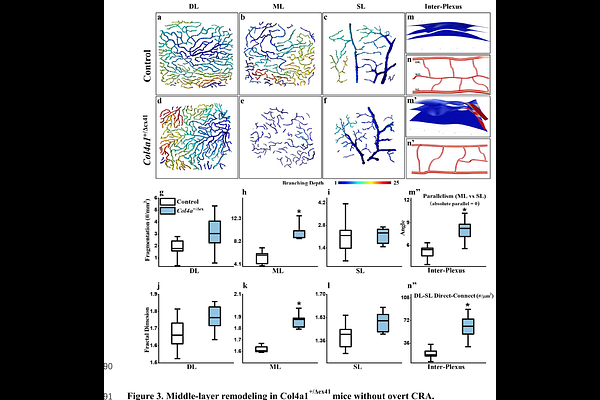
AbstractThe neurosensory retina is one of the most metabolically active tissues in the body and a uniquely accessible extension of the central nervous system, where neuronal and vascular structures can be visualized non-invasively. Its accessibility and highly organized laminar architecture make it a powerful model for studying vascular development and a window into systemic health. Although computational analyses of retinal images have enabled risk assessment for ocular and systemic diseases, most vascular studies rely on two-dimensional frameworks with limited resolution of capillary structure and layer-specific organization. Here, we present a high-resolution three-dimensional (3D) imaging and analysis pipeline enabling quantification of retinal microvasculature and extraction of structural and network metrics across vascular layers. We apply this approach to two mouse models of aberrant retinal vascular development: one with spontaneous postnatal chorioretinal neovascularization and another with disrupted neurovascular lattice formation and layered organization in early life. Across both pathologic contexts, 3D analysis provides detailed characterization of vascular architecture and identifies early vulnerability of the intermediate layer plexus (IMP) as a sensitive indicator of abnormal remodeling and neovascularization. This framework enables precise characterization of retinal vasculature and establishes a foundation for identifying new retinal biomarkers with potential relevance to neurovascular and systemic disease.