Learning Intrinsic Dynamics in Latent World Models

Learning Intrinsic Dynamics in Latent World Models
Jiamin Shi, Yuanhong Zhang, Zhiyang Liu, Jiawei Sun, Jingwen Fu
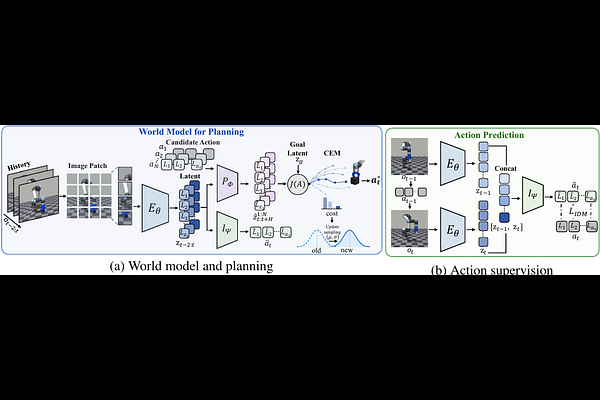
AbstractLearning intrinsic dynamics---the relationship between actions and their consequences---is essential for world models. However, visual variations unrelated to the underlying control process can obscure this relationship in learned representations. We investigate the connection between action predictability, defined as the ability to reconstruct an action from consecutive latent states, and the preservation of intrinsic dynamics. Our central hypothesis is that encouraging action predictability discourages representations from discarding the distinctions between different actions and their consequences. We provide two complementary forms of evidence for this connection. Theoretically, we derive a positive lower bound on squared inverse prediction error when the encoder merges distinguishable outcomes of different actions from the same state and appearance, and show that forward prediction can still be exact on those transitions. Empirically, controlled appearance-diversity comparisons, supervision interventions, and latent probes support the role of action prediction in preserving control-relevant transition information. We instantiate action predictability with Concat IDM, which predicts actions from concatenated latent states and updates the shared encoder using action labels already available in offline trajectories, without changing the test-time planner. Across three independent training runs on Push-T with 24 appearances, Concat IDM increases planning success from 9.1% to 77.2%; its paired improvement is 52.9 percentage points larger than that observed with a single appearance. Together, these findings support action predictability as an inductive bias toward intrinsic dynamics and demonstrate the practical benefits of Concat IDM for latent planning under visual diversity.