Disentangling site-specific and shared local adaptation in a classic system of repeated evolution

Disentangling site-specific and shared local adaptation in a classic system of repeated evolution
Roesti, M.; Roesti, H.; Sudasinghe, H.; Nesvadba, N.; Saladin, V.; Peichel, C. L.
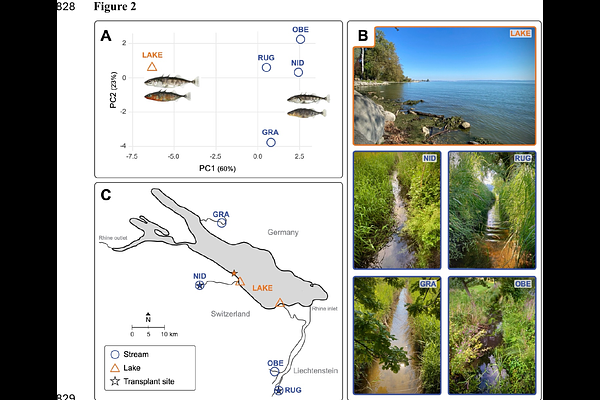
AbstractRepeated divergence across contrasting habitats is widely used to infer natural selection and local adaptation. However, such inferences remain inherently correlative and capture only adaptation shared within habitat types, thereby missing site-specific adaptation among populations from the same habitat type. Field transplant experiments test adaptation more directly by measuring fitness in nature, but they are typically limited to pairwise reciprocal exchanges between populations and therefore cannot separate the contributions of shared habitat-level and site-specific adaptation to fitness. Here, we overcome these limitations by extending the typical transplant framework to include multiple populations transplanted both within and across habitat types. We apply this framework to lake-stream stickleback, a classic system for studying local adaptation via repeated divergence. Specifically, we transplanted laboratory-reared fish from a panmictic lake population and four independently evolving stream populations into one lake and two stream sites. Stream fish outperformed lake fish in streams and vice versa, providing evidence for adaptive lake-stream divergence. Strikingly, local stream fish also outperformed foreign stream fish at both stream sites. This site-specific advantage was twice as large as the advantage of foreign stream fish over lake fish, which reflects the fitness benefit of shared stream adaptation. These results show that in this system, the majority of fitness-relevant evolutionary variation is site-specific and therefore missed by approaches that rely on repeated divergence to infer adaptation. More broadly, this underscores the importance of ecological scale for understanding adaptation and evolutionary predictability.