Primate visual cortex spontaneously computes the beauty of objects

Primate visual cortex spontaneously computes the beauty of objects
Schumann, P. A.; Stecher, R.; Hebart, M. N.; Kaiser, D.
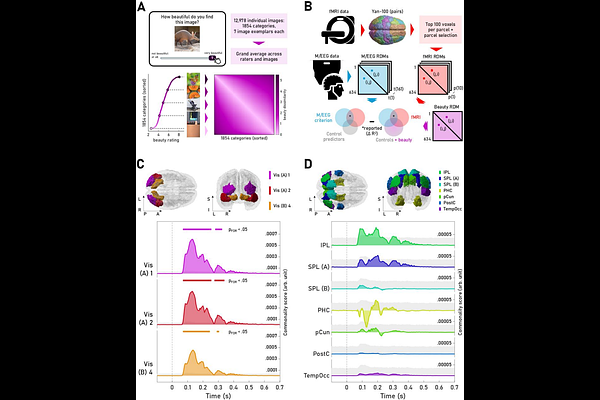
AbstractDuring everyday vision, beauty is a spontaneous experience. Perceived beauty varies substantially across object categories: We find puppies more beautiful than moths and roses more beautiful than potatoes. Here, we provide evidence that early processing in human and non-human primate visual cortex already reflects perceived beauty, even without deliberate judgments of beauty. First, in a combined EEG-fMRI analysis, we show that beauty ratings for hundreds of object categories from the THINGS database are predicted from neural responses measured in separate groups of human participants viewing the same images without explicit beauty judgments. Beauty-related representations emerged in occipital visual cortex within 100ms and peaked around 130ms. Second, multi-unit activity in macaque visual cortex also predicted human beauty judgments, despite the animals highly limited knowledge of the objects. These results indicate a perceptual basis for the beauty of visual categories, which may underlie spontaneous preference formation in everyday situations.