Decoding the Critique Mechanism in Large Reasoning Models

Decoding the Critique Mechanism in Large Reasoning Models
Hoang Phan, Quang H. Nguyen, Hung T. Q. Le, Xiusi Chen, Heng Ji, Khoa D. Doan
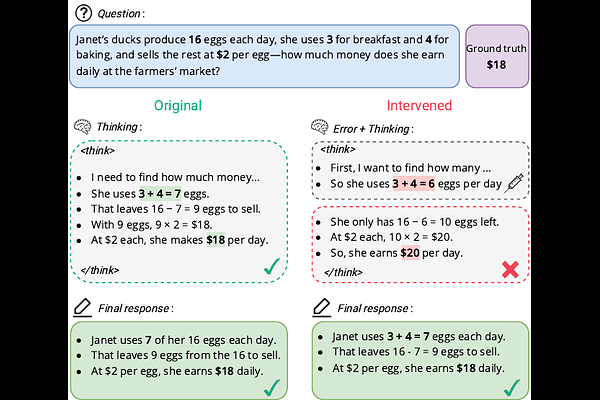
AbstractLarge Reasoning Models (LRMs) exhibit backtracking and self-verification mechanisms that enable them to revise intermediate steps and reach correct solutions, yielding strong performance on complex logical benchmarks. We hypothesize that such behaviors are beneficial only when the model has sufficiently strong "critique" ability to detect its own mistakes. This work systematically investigates how current LRMs recover from errors by inserting arithmetic mistakes in their intermediate reasoning steps. Notably, we discover a peculiar yet important phenomenon: despite the error propagating through the chain-of-thought (CoT), resulting in an incorrect intermediate conclusion, the model still reaches the correct final answer. This recovery implies that the model must possess an internal mechanism to detect errors and trigger self-correction, which we refer to as the hidden critique ability. Building on feature space analysis, we identify a highly interpretable critique vector representing this behavior. Extensive experiments across multiple model scales and families demonstrate that steering latent representations with this vector improves the model's error detection capability and enhances the performance of test-time scaling at no extra training cost. Our findings provide a valuable understanding of LRMs' critique behavior, suggesting a promising direction to control and improve their self-verification mechanism. Our code is available at https://github.com/mail-research/lrm-critique-vectors.