Omics-analyses of Fermented Onion pickle in Shaping Gut Microbiota and Immune Response in Women: A Community-Based Trial in Pakistan

Omics-analyses of Fermented Onion pickle in Shaping Gut Microbiota and Immune Response in Women: A Community-Based Trial in Pakistan
Hafeez, S. H.; Farooq, S.; Iqbal, J.; Ahmed, K.; Ahmed, S.; Umrani, F.; Jakhro, S.; Qureshi, K.; Moore, S.; Ali, S. A.; Iqbal, N. T.
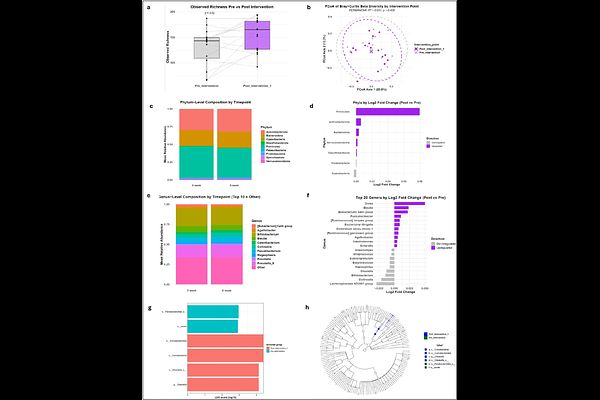
AbstractA fermented-food intervention trial conducted in Pakistan suggested beneficial changes in the composition of the gut microbiota in healthy women. Using a subset (n=17) of the same participants, this study further investigates the impact of fermented food (onion pickle) on gene expression levels using RNA transcriptomics, with a focus on host-microbiome interactions. After consuming pickles (50g/day) for eight weeks, blood and stool samples of participants were collected at baseline and post-intervention to assess inflammatory markers, 16S rRNA gene sequencing, clinical parameters, and RNA sequencing. Among inflammatory biomarkers, lipocalin (LCN-2) levels significantly decreased (pre=86.5{+/-}80.1ng/mL, post=61.0{+/-}59.0 ng/mL, p=0.04, paired T-test). Additionally, the intervention downregulated pathways (p<0.05) involved host responses to microbial stimuli, including response to bacterial origin, chemotaxis, and response to lipopolysaccharide. In gut microbiota, observed -diversity significantly increased post-intervention (p=0.02). Linear discriminant analysis effect size (LEfSe) revealed differential expressions (LDA [≥] 2.0) of Olsenella and Coriobacteriales at week-8, where Olsenella sp. showed a significant negative correlation with LCN-2 (R=-0.36, p<0.05, Spearmans correlation). These findings suggest that fermented onion pickle consumption for eight weeks modestly alters gut microbial diversity and composition and is associated with reduced inflammatory markers and altered host immune-related gene expression, potentially improving intestinal health.