Biphasic bacterial community assembly predicted from generalized first principles of monoculture growth and inferred species interactions

Biphasic bacterial community assembly predicted from generalized first principles of monoculture growth and inferred species interactions
Guex, I.; Staubli, M. L.; Sintsova, A.; Sentchilo, V.; Causevic Butzberger, S.; Vouillamoz, A.; Bailey, C.; Ruscheweyh, H.-J.; Sunagawa, S.; Mazza, C.; van der Meer, J. R.
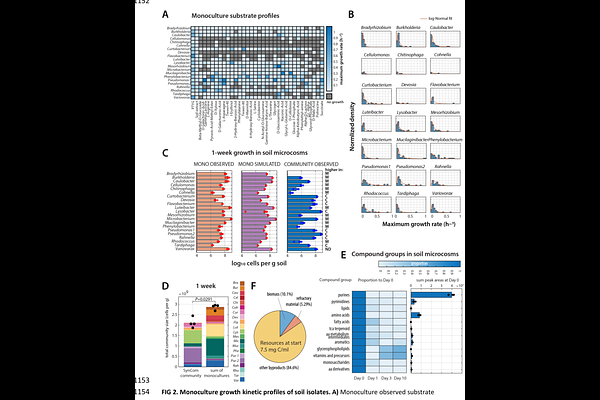
AbstractMicrobial communities occur in all habitats, yet how individual growth on available nutrients scales to community assembly remains poorly understood. This gap stems largely from the unknown effects of species interactions. These interactions arise because individual populations both consume and transform primary substrates into metabolites exploitable by others, and because parasitic and predatory mechanisms can release cellular building blocks that enable nutrient reuse. Here, we present a mathematical framework that predicts community growth and compositional succession from monoculture growth kinetics, resource availability, and species interaction parameters. To parametrize species interactions, we use a simulated-annealing optimization algorithm to search parameter space for sets that minimize the difference between modeled community growth and experimental time series from soil microcosms inoculated with defined communities of 20 or 21 soil isolates, with or without an opportunistic bacteriovorous member. The optimized interaction parameter sets were then used to predict growth dynamics in an independent 21-member community and in species drop-out communities. We find that community development is biphasic: an initial phase dominated by competition for primary resources driven by inherent strain growth kinetics, followed by a phase governed by cross-feeding and biomass formation on released byproducts. Paired metatranscriptomic analysis corroborated predicted shifts in individual growth states and revealed metabolic repurposing associated with the sudden renewed availability of metabolites and cellular building blocks. Model simulations that excluded species interactions reproduced only one-fifth of the observed community biomass, highlighting the importance of cross-feeding for soil community growth. Overall, models that integrate monoculture growth kinetics with inferred species interactions can predict the dynamics of medium-complexity communities from starting inocula even when environmental nutrient composition is largely unknown.