Two inner dust clumps in PDS 70. A third protoplanet traced by trojan material or a substructured inner disk?

Two inner dust clumps in PDS 70. A third protoplanet traced by trojan material or a substructured inner disk?
O. Balsalobre-Ruza, V. Christiaens, N. Huélamo, I. Hammond, M. Benisty, S. Lacour, D. Blakely, R. G. van Holstein, J. Latour, J. Lillo-Box, Z. Wahhaj, D. Trevascus, O. Absil, J. Bae, C. Charalambous, I. de Gregorio-Monsalvo, I. Mendigutía, C. Petrovich, Á. Ribas, S. Juillard
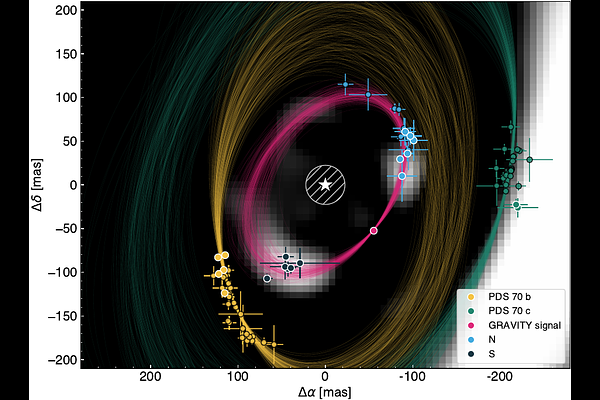
AbstractThe PDS 70 cavity hosts two confirmed directly imaged protoplanets and a third inner planet candidate (~13au). Despite its Keplerian motion, its unusually blue spectrum challenges a planetary interpretation. We further investigate the presence and nature of a third inner planet using new SPHERE and GRAVITY+ observations. Using the star-hopping strategy, we obtained coronagraphic IRDIS polarimetric observations in the H-band, and non-coronagraphic observations with IRDIFS in the YJHK-bands. We also searched for a planetary signal with GRAVITY in the 4UT configuration. We consistently detect two elongated inner emissions with SPHERE: the previously proposed planet candidate and another feature that appears to share the same orbit while leading it by ~120$^\circ$. Both features show dust-scattered-light spectra but different colors, possibly indicating different grain sizes. Such configuration is consistent with co-orbital dust accumulated at the stable Lagrangian regions of a distinct and yet undetected planet. GRAVITY yields a marginal (3$σ$) detection at the predicted location along the same orbit ($ρ=76.2\pm0.29$mas, PA=$226.50\pm0.21^\circ$), and consistent with a ~3$M_{\rm Jup}$ planet. This new planet candidate is aligned with a narrow shadow that we detect in the outer disk. We also detect polarized emission very close to the star likely arising from the inner disk ($i\sim50^\circ$, PA $\sim135^\circ$). The apparent embedding of the two dust clumps within it motivates an inner-disk origin as an alternative scenario. We conclude that the previously reported third planet candidate traces a dust clump either trailing an unseen planet on the same orbit or a rotating substructure within the inner disk. Further observations are needed to test these scenarios. Confirming the new GRAVITY planet candidate would support co-orbital substructures as indirect tracers of protoplanets.