Ecological specificity and interconnectivity in Danish environmental resistomes

Ecological specificity and interconnectivity in Danish environmental resistomes
Yang, Y.; Brown, C. L.; Liu, L.; Sereika, M.; Jensen, T. B. N.; Albertsen, M.; Nielsen, P. H.; Singleton, C. M.
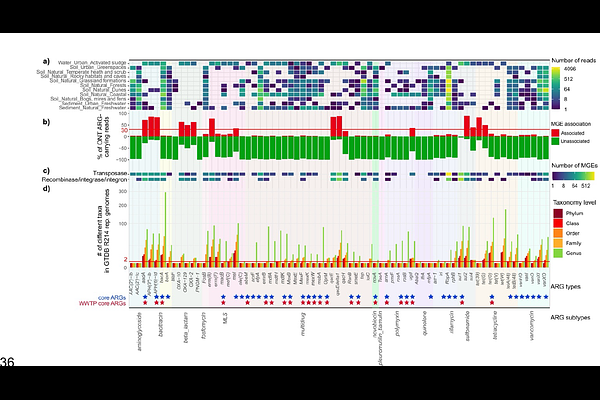
AbstractEnvironmental resistome comprises diverse antibiotic resistance genes (ARGs) that can play critical roles in "One Health", facilitating the evolution, persistence, and dissemination of microbial resistances. Yet, knowledge gaps exist in resistome structures and ecological connectivity across various ecosystems at a national scale. Here, we combined nationwide extensive short- and long-read sequencing efforts for soils, sediments, waters and wastewater treatment plants across Denmark to resolve resistome composition, habitat specificity and connectivity. From over 7,000 sequenced environmental samples (24 Tb of metagenomic data) that were classified into 21 distinct habitat classifications, resistomes exhibited habitat-specific patterns. We identified core ARGs for establishing environmental baseline of ARGs, and habitat-associated indicator ARGs facilitating source tracking. Using 110 deep long-read metagenomes (9 Tb data), we showed that only a subset of cross-habitat commonly-abundant ARGs showed elevated associations with MGEs and broad host range, suggesting unequal resistome connectivity across ecosystems among environmental ARGs. Additionally, although natural habitats had much lower resistome relative abundance and transferability than human-associated habitats, some mobile environmental ARGs exhibited links to those in human pathogens. These findings establish an ecological framework for interpreting environmental resistomes and prioritizing ARGs for environmental surveillance in the One Health framework.