The Bayesian view of DESI DR2: Evidence and tension in a combined analysis with CMB and supernovae across cosmological models

The Bayesian view of DESI DR2: Evidence and tension in a combined analysis with CMB and supernovae across cosmological models
Dily Duan Yi Ong, David Yallup, Will Handley
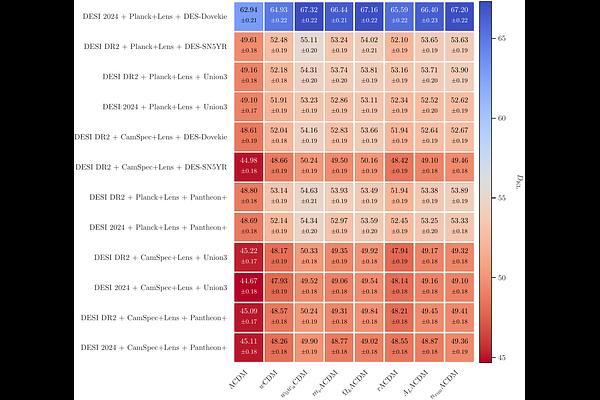
AbstractWe apply the unimpeded framework to perform a fully Bayesian reanalysis of the DESI DR2 data, using nested sampling with PolyChord to compute evidences for $Λ$CDM and seven extensions across combinations of DESI DR1/DR2, Planck CMB, supernovae (Pantheon+, Union3, DES-SN5YR, DES-Dovekie), and DES-Y1 weak lensing. The Bayesian Ockham's razor penalises extended models, yielding weaker or opposite preferences compared to $Δχ^2$-based analyses. For DESI DR2 BAO combined with Planck CMB alone, the DESI collaboration's $3.1σ$ frequentist preference for $w_0w_a$CDM is eliminated entirely: we obtain ${\ln B = -0.57{\scriptstyle\pm0.26}}$, modestly favouring $Λ$CDM. Adding the corrected DES-Dovekie supernova calibration maintains this concordance (${\ln B = -0.01{\scriptstyle\pm0.27}}$). However, when the original DES-SN5YR calibration is included instead, the DESI collaboration's $4.2σ$ result survives the Bayesian Ockham penalty as a $3.07{\scriptstyle\pm0.10}\,σ$ preference (${\ln B = +3.32{\scriptstyle\pm0.27}}$). That this signal persists despite the Ockham penalty makes the role of tension quantification essential: our analysis traced the preference to the DES-SN5YR calibration error, which introduced a $2.95{\scriptstyle\pm 0.04}\,σ$ conflict with DESI DR2 within $Λ$CDM -- a tension that stands out from the grid -- reduced to $1.96{\scriptstyle\pm 0.04}\,σ$ once the calibration was corrected. With the calibration corrected, the Bayesian evidence for dynamical dark energy vanishes.