Between Friends and Foes: Evolutionary Diversification in Mutualistic-Antagonistic Networks

Between Friends and Foes: Evolutionary Diversification in Mutualistic-Antagonistic Networks
Jäger, F.; Loeuille, N.; Yacine, Y.; Allhoff, K. T.
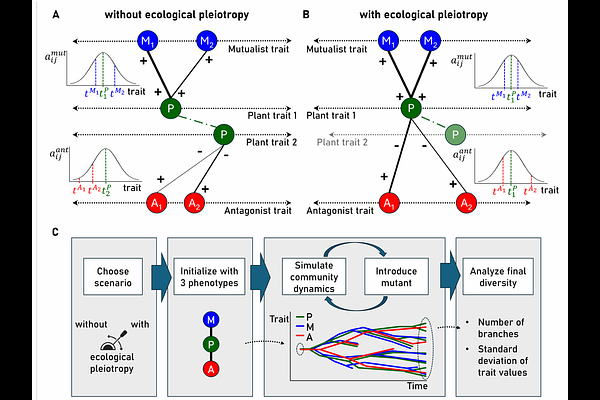
AbstractBiotic interactions can drive evolutionary diversification, but the underlying mechanisms differ depending on the type of interaction. For instance, Ehrlich and Raven's escape-and-radiate coevolution provides a pathway of diversification in antagonistic interactions, whereas in mutualistic networks, coevolution is hypothesized to result in trait convergence rather than diversification. The combined effect of mutualism and antagonism on diversification remains unclear, even though organisms naturally engage in multiple types of interactions simultaneously. Using an eco-evolutionary simulation model, we investigate diversification in tripartite ecological networks such as plant-pollinator-herbivore networks. We find that diversification patterns vary according to the way mutualism and antagonism are connected on the trait level. If the two interactions are governed by uncorrelated plant traits, we observe little diversification in the mutualistic and substantial diversification in the antagonistic subnetwork. By contrast, if the same plant trait mediates both mutualism and antagonism (an example of 'ecological pleiotropy'), diversification rates in all guilds become interdependent. In this case, even the mutualistic guild diversifies considerably when antagonism is strong, while strong mutualism restricts diversification also in the antagonistic guild. Our study underlines that the inclusion of multiple interaction types is necessary to advance our understanding of evolutionary dynamics in ecological networks.