Gravitational Waves from Population III Black Hole Mergers in Primordial Gas Disks: Constraining Astrophysical Scenarios with the Laser Interferometer Space Antenna and the Einstein Telescope

Gravitational Waves from Population III Black Hole Mergers in Primordial Gas Disks: Constraining Astrophysical Scenarios with the Laser Interferometer Space Antenna and the Einstein Telescope
Maulik Bhatt, Lucio Mayer, Pedro R. Capelo, Simona Gallerani, Andrea Pallottini
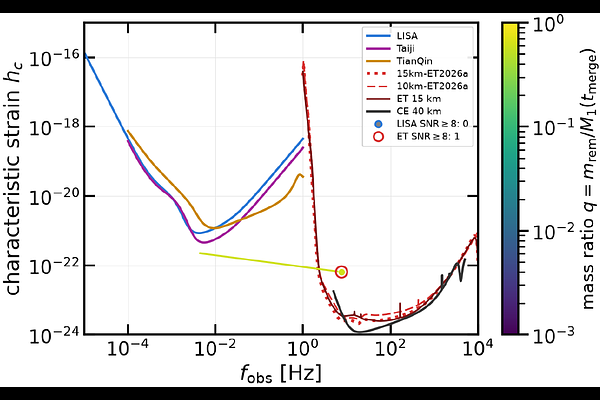
AbstractThe first generation of metal-free Population III (Pop~III) stars provides a possible formation channel for the black hole (BH) seeds in the early Universe. Their remnants may grow through gas accretion and mergers, producing gravitational wave (GW) signals detectable by future observatories. We develop a semi-analytical model of fragmentation in a primordial self-gravitating gas disk within minihaloes at $z > 15$, motivated by high-resolution cosmological simulations. The resulting Pop~III stars form around a central primary, some leaving massive BH remnants that migrate towards the central BH through dynamical friction from gas and dark matter, while the central BH grows through accretion and mergers. For a $10^6~{\rm M_\odot}$ halo at $z=20$, we explore how the initial mass function (IMF) and BH accretion efficiency affect detectability with the Laser Interferometer Space Antenna (LISA) and the Einstein Telescope (ET). We find that both detectors can potentially reveal mergers of Pop III remnant BHs, but favor different astrophysical conditions. LISA pinpoints more massive central BHs ($\sim10^3$-$10^4 {\rm M_\odot}$), grown rapidly through mutual mergers alongside efficient gas accretion ($f_{\rm Edd}=1$), and a relatively top-heavy IMF ($α=0.8$). In contrast, detectability with ET favors lower-mass BHs, with less efficient accretion ($f_{\rm Edd}=0.01$) and a steeper IMF ($α=1.5$). These results highlight the potential of LISA and ET to probe Pop~III BH formation, growth, and mergers across different regions of parameter spaces, jointly constraining Pop~III star formation and early BH seed evolution.