A genetically buffered helicase network promotes tolerance of G-quadruplex stabilization in Saccharomyces cerevisiae

A genetically buffered helicase network promotes tolerance of G-quadruplex stabilization in Saccharomyces cerevisiae
Gray, S. J.; Bochman, M. L.
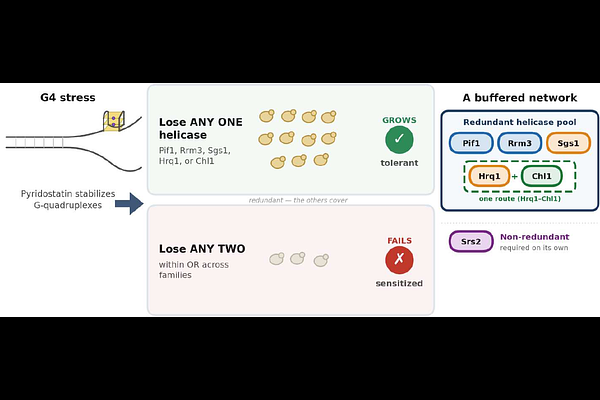
AbstractG-quadruplexes (G4s) are non-canonical DNA secondary structures that can impede DNA replication and transcription and provoke genome instability, and DNA helicases of the PIF1 and RecQ families have long been regarded as the principal enzymes that resolve them. To directly test the relative contributions of these families, we measured the growth of Saccharomyces cerevisiae helicase mutants in the presence of the G4-stabilizing ligand pyridostatin (PDS). Unexpectedly, no single PIF1- or RecQ-family mutant was sensitized to PDS relative to wild type. Sensitivity emerged only in double mutants, and it did so for combinations both within a single family and across the two families. This pattern indicates that G4 tolerance is buffered by the combined, partially interchangeable, activity of multiple helicases rather than by any one family. To ask whether this redundancy extends beyond the canonical players, we tested two additional helicases whose human orthologs are implicated in G4 metabolism: Chl1 (DDX11/ChlR1) and Srs2 (RTEL1). Loss of Chl1 alone did not sensitize cells, and chl1 combined with PIF1- or RecQ-family mutations recapitulated the redundancy pattern with one informative exception: chl1 hrq1 remained PDS-tolerant, placing Chl1 and Hrq1 in a shared genetic route. In contrast, srs2 was the sole single mutant sensitized to PDS, defining a non-redundant requirement that no other helicase compensates. We integrate these results into a two-layer model in which a redundant helicase pool resolves G4-associated genomic stress, while a non-redundant Srs2 function manages its recombinogenic consequences. Our findings reframe G4 maintenance from a family-specific activity into a distributed, buffered network.