Diagnostic Performance of Fluorescence-Based Rapid On-Site Specimen Evaluation for Helicobacter pylori Antimicrobial Susceptibility Testing Before and After Algorithm Optimization: A Two-Round Comparative Study

Diagnostic Performance of Fluorescence-Based Rapid On-Site Specimen Evaluation for Helicobacter pylori Antimicrobial Susceptibility Testing Before and After Algorithm Optimization: A Two-Round Comparative Study
Li, B.; Zhang, L.; Hou, Y.; Wu, K.; Han, J.; Liu, J.; Zhang, J.; Yang, M.
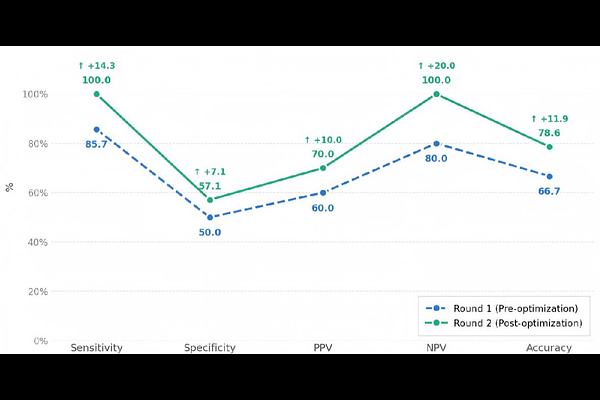
AbstractObjective This study was designed to evaluate the diagnostic performance of fluorescence-based rapid on-site specimen evaluation (F-ROSE) for antimicrobial susceptibility testing of Helicobacter pylori (H. pylori) and to compare test performance before and after iterative optimization of fluorescence image acquisition and of the artificial intelligence (AI) recognition algorithm, using two consecutive rounds of paired testing, so as to provide trial data supporting clinical implementation of rapid susceptibility testing. Methods Forty patients with a urea breath test (UBT) or rapid urease test (RUT) positive for H. pylori within the preceding 2 weeks, together with strongly positive endoscopic findings, were prospectively enrolled. In order of enrollment they were allocated to two rounds in which F-ROSE was compared with culture-based susceptibility testing. Twenty patients were tested in round 1 on an automated fluorescence immunoassay scanner running the original algorithm; a further 20 were tested in round 2 with the optimized algorithm. With in vitro culture and E-test as the reference standard, sensitivity, specificity, positive predictive value (PPV), negative predictive value (NPV) and accuracy of F-ROSE were calculated for each round for amoxicillin, levofloxacin hydrochloride and clarithromycin, and agreement between methods was assessed with Cohen kappa. Receiver operating characteristic (ROC) analysis was used to identify the optimal cutoff of the fluorescence residual rate (FRR) and to determine how far threshold adjustment improved performance. Results Culture succeeded in 15 patients in round 1 and in 14 patients in round 2, leaving 29 evaluable samples. Overall diagnostic performance after algorithm optimization was clearly better than before. Pooled across the three antibiotics, sensitivity was 92.9%, specificity 71.0% and accuracy 77.8% before optimization; after optimization sensitivity rose to 100.0%, specificity increased slightly to 74.2% and accuracy to 81.0%. NPV reached 100.0% for all three agents after optimization, and no resistant isolate was missed. The gain was largest for clarithromycin, for which sensitivity rose from 85.7% to 100.0%, accuracy from 66.7% to 78.6% and kappa from 0.348 to 0.571, indicating a clear improvement in agreement between the two methods. ROC analysis showed that drug-specific optimal cutoffs derived from the Youden index improved specificity appreciably compared with the uniform 50% FRR threshold currently applied, the gain being most evident for levofloxacin hydrochloride. Conclusions With sharper fluorescence images and an improved AI recognition algorithm, F-ROSE performs better in H. pylori susceptibility testing, and the reduction in missed resistant strains is particularly noteworthy; the assay is therefore a plausible option for rapid susceptibility screening in clinical practice. Multicenter studies with larger samples are still required to confirm the stability of the technique.