Oxygenated False Positive Biosignatures in Mars-like Exoplanet Atmospheres

Oxygenated False Positive Biosignatures in Mars-like Exoplanet Atmospheres
Margaret Turcotte Seavey, Shawn Domagal-Goldman, Amber Young, Jaime Crouse, Jacob Lustig-Yaeger, Giada Arney
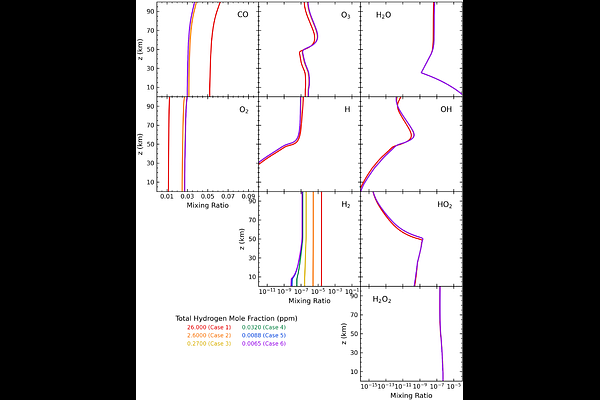
AbstractOxygen is a well-studied biosignature. Studying potential abiotic pathways for O2 build-up in exoplanet atmospheres is essential for evaluating whether the detection of O2 would constitute a biosignature detection on other worlds. Previous modeling efforts in the literature demonstrated that detectable abiotic O2 and O3 can be produced through CO2 photolysis for rocky planets around M dwarf stars. Building on modeling approaches from previous studies, we use photochemical simulations to reassess the conditions under which O2 and O3 may accumulate through similar photochemical mechanisms. Using a Mars-like atmospheric composition and planetary parameters, we vary the hydrogen mole fraction to assess how changes in HOx chemistry can affect the resulting accumulation of abiotic O2 and O3. Across the range of hydrogen mole fractions explored, we obtain a maximum O2 abundance of ~2.7% for H = 0.0065 ppm, about an order of magnitude lower than reported in the literature. This reduction is consistent with the elevated water vapor abundance adopted in our simulations, which enhances HOx-driven recycling of CO and O and thereby suppresses the accumulation of O2 and O3. Our improved understanding of how this cycle results in atmospheric false positive biosignatures in crucial towards developing future exoplanet characterization strategies.