Shigatse Astronomical Site Testing. I. Cloud-cover Climatology and Selected Local Meteorological Conditions

Shigatse Astronomical Site Testing. I. Cloud-cover Climatology and Selected Local Meteorological Conditions
Baiyu Zhang, Hejun Yang, Xiaojun Dong, Lingling Wang, Juean Luobu, Minfeng Gu, Xiyan Peng, Hao Luo, Yindun Mao, ZhaoXiang Qi, Basangzeren, Qihang He, Guojie Feng, Chunhai Bai, Ali Esamdin, Wenbo Gu, Siqi Wang, Zihuang Cao
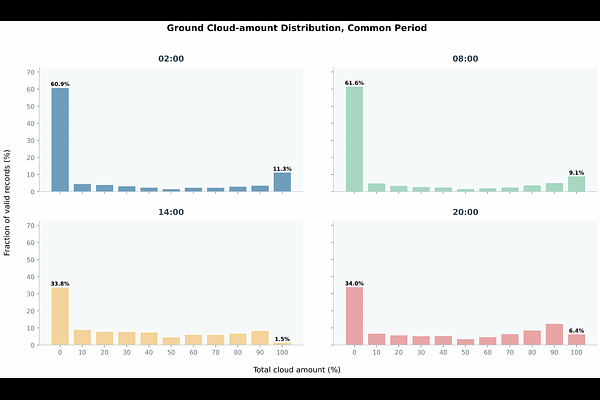
AbstractAs the first paper in a Shigatse astronomical site-testing series, we present a multi-source assessment of cloud cover and selected local meteorological conditions at the Shigatse 40 m site on the southern Tibetan Plateau. The study combines CALIPSO-GOCCP active-lidar climatology, ISCCP HXG passive-satellite cloud fields, conventional total-cloud-amount observations from the Shigatse Meteorological Station, and on-site Weather Station measurements. Together, these records characterize Shigatse as a southern-plateau monsoon-transition cloud regime: the active-lidar climatology gives a moderate-to-low annual cloud fraction, and the cloudier months are concentrated in the June--September monsoon interval. In GOCCP, the annual mean cloud fraction is 42.1%, while the October--May low-cloud season has a mean cloud fraction of 26.3%, compared with 73.7% during the June--September monsoon interval. ISCCP gives higher absolute cloud fractions but supports the same seasonal phase and local spatial placement. The aligned 1988--2013 meteorological-station record gives a total-cloud-amount <=40% fraction of 80.7% during October--May, rising to 90.7% in the November--January core, and decreasing to 39.9% during June--September. The 2024--2025 Weather Station archive further shows high fractions of valid samples satisfying the adopted meteorological criteria during the low-cloud months: 92.6% for the October--May night-time proxy and 94.6% for the corresponding 24 h samples. These results identify Shigatse as a measured lower-latitude southern-plateau cloud-cover reference within China's site-testing network, with a well-defined October--May low-cloud observing period and a Shigatse--Ali low-cloud corridor for subsequent regional site testing.