A HINSA view of cosmic-ray ionization in IC 348 and NGC 1333: evidence for a strong low-energy cosmic-ray disparity

A HINSA view of cosmic-ray ionization in IC 348 and NGC 1333: evidence for a strong low-energy cosmic-ray disparity
Gan Luo, Marco Padovani, Daniele Galli, Thomas G. Bisbas, Brandt A. L. Gaches, Di Li, Marko Krčo, Ningyu Tang
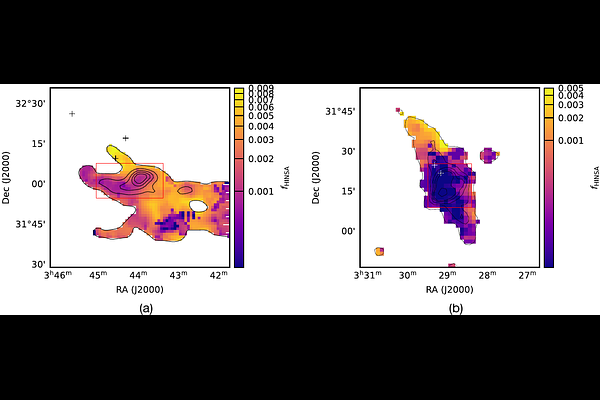
AbstractThe cosmic-ray ionization rate (CRIR) is one of the fundamental parameters influencing the chemical and dynamical evolution of molecular clouds. Although observations in recent years have revealed high CRIR values in massive star-forming regions and in the vicinity of protostars, the sources and acceleration mechanisms of cosmic rays remain uncertain. In this work, we present our new estimates of CRIR using the H\,{\sc i} narrow self-absorption (HINSA) technique towards two nearby low-mass star-forming clouds, IC~348 and NGC~1333. In both clouds, the CRIR decreases with increasing H$_2$ column density, but IC~348 exhibits values that are roughly an order of magnitude higher than those in NGC~1333. To interpret this contrast, we model the low-energy spectrum of CRs in a finite slab attenuation framework, using additional constraints from the high-energy CR spectrum inferred from Fermi $γ$-ray observations. The best-fit spectra reproduce the observed CRIR profiles and the contrast between IC~348 and NGC~1333 suggests an order of magnitude difference in low-energy CR populations, likely originating from local acceleration sources beyond protostars (e.g., stellar-wind termination shocks), and partly from the same sources responsible for the GeV $γ$-ray excess. Although uncertainties in cloud structure and gas density may affect the absolute CRIR values, they do not erase the pronounced disparity between the two regions.