Pyruvate-driven hydrogen production promotes polyphenol bioconversion by gut bacteria

Pyruvate-driven hydrogen production promotes polyphenol bioconversion by gut bacteria
Eshaghi Gorji, M.; Lee, P.-K.; Liu, J.; Zheng, L.; Xia, X.; Yu, X.; Ziyi, M.; Li, M. M.-J.; Dai, L.; Zhao, D.
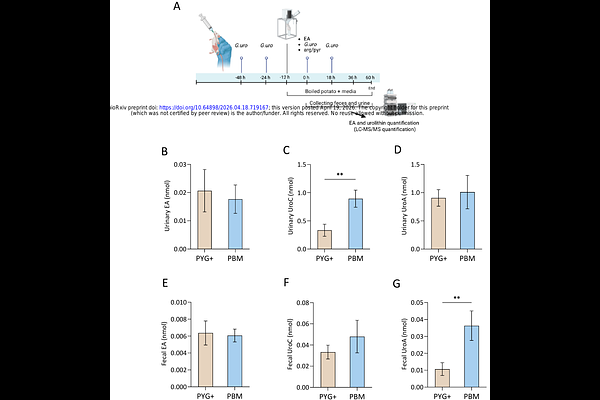
AbstractGut microbial biotransformation of poorly absorbable polyphenols into bioactive, bioavailable metabolites is increasingly recognized as a key mechanism underlying their health benefits of polyphenols. Microbial ellagic acid (EA)-to-urolithin conversion represents a typical example, but the environmental factors that facilitate such metabolism remain underexplored. We discovered that urolithin production by a gut commensal bacterium, Gordonibacter urolithinfaciens (G. uro), is metabolically repressed by arginine. To overcome such limitations, we developed PhenolBoost Medium (PBM) that induces a metabolic shift by suppressing the arginine deiminase pathway while activating pyruvate metabolism and hydrogen production in G. uro, thereby driving urolithin dehydroxylation. Transcriptomic profiling and 13C-isotopic tracing analysis revealed that pyruvate metabolism in PBM upregulates hydrogenase expression, facilitating the dehydroxylation of EA. PBM also promoted the complete conversion of EA to urolithin A in G. uro-Enterocloster bolteae co-culture, and other polyphenol biotransformations. In addition, co-culturing G. uro with hydrogen-producing Bacteroides species significantly increased urolithin production. Furthermore, an arginine-limited, pyruvate-enriched dietary regimen proved effective in vivo, resulting in significantly higher urolithin production and bioavailability in a mouse model. Our findings reveal the critical role of hydrogen in facilitating polyphenol dehydroxylation, and offer a viable nutritional strategy for boosting microbial production of beneficial metabolites from polyphenols.