On the origin of Milky Way binary black holes with LISA

On the origin of Milky Way binary black holes with LISA
Charles Dalang, Enrique Gaztanaga
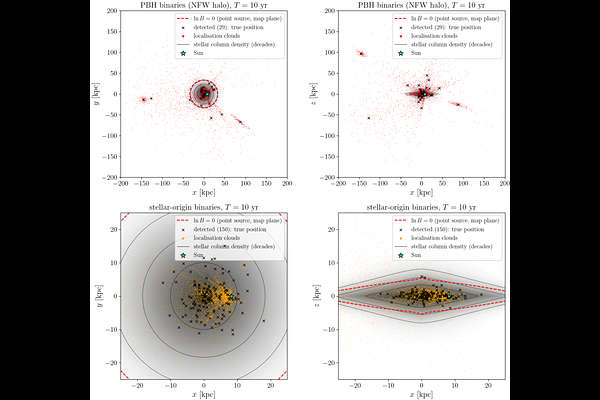
AbstractPrimordial black holes (PBHs) may constitute a fraction of dark matter, but distinguishing them from black holes of stellar origin remains a major challenge. We propose a new method based on the three-dimensional localization of Galactic Binary Black Holes (BBHs) by the Laser Interferometer Space Antenna (LISA). While stellar-origin BBHs are expected to be associated with the stellar distribution of the Milky Way, PBHs may trace its more extended dark matter halo. We introduce a spatial overlap ratio that compares the gravitational-wave localization of each binary with the normalized stellar and dark matter density profiles. Using a Fisher-matrix forecast and 1000 Monte Carlo realizations of a 10-year LISA mission, we find that detecting three BBHs with an overlap ratio ln B < 0 occurs in approximately 99% of simulations where BBHs trace dark matter, but in fewer than 0.1% of simulations where they follow the stellar distribution, even when including a stellar halo containing 3% of the Galactic stellar mass. These results suggest that the localization of only a few Galactic BBHs could provide strong evidence for a primordial population, offering an independent test of their possible contribution to dark matter.