Galaxies at z > 10: ΛCDM predicts increased Star Formation Efficiency

Galaxies at z > 10: ΛCDM predicts increased Star Formation Efficiency
Francisco Prada, Peter Behroozi, Tomoaki Ishiyama, Enrique Pérez, Anatoly Klypin, Xin Wang, José Ruedas
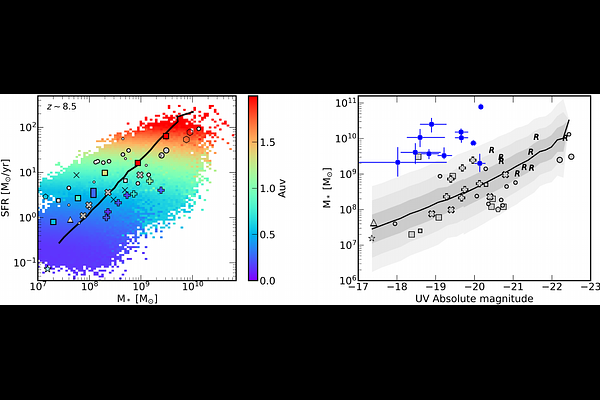
AbstractWe show that the rest-frame UV statistics and global properties of galaxies at 7 <= z <= 14 are naturally reproduced within the standard ΛCDM framework when galaxy formation is modeled with UniverseMachine applied to the high-resolution Uchuu N-body simulation. Our model matches the UV luminosity functions over five magnitudes and reproduces the evolution of the UV (and inferred star formation rate) density once internal dust attenuation is included. Comparisons with spectroscopically confirmed JWST/HST galaxies show good agreement with the stellar mass-SFR and stellar mass-UV luminosity relations. In contrast, earlier claims of insufficient stellar masses at z=8 are inconsistent with our model and are likely driven by systematic uncertainties, including AGN contamination, dust attenuation, and the lack of JWST/MIRI constraints. A key prediction is that the star-formation efficiency increases with redshift at fixed halo mass, reaching 2-3 percent of baryons converted into stars by z=10-12. These results demonstrate that current JWST observations of early galaxy populations can be explained within the ΛCDM framework.