Analytical Modeling of Far-Field Wavefront Error with Beam-Waist and Lateral-Shift Effects in Spaceborne Laser Interferometry

Analytical Modeling of Far-Field Wavefront Error with Beam-Waist and Lateral-Shift Effects in Spaceborne Laser Interferometry
Ya-Zheng Tao, Rui-Hong Gao, Guangzhou Xu, Yue-Liang Wu
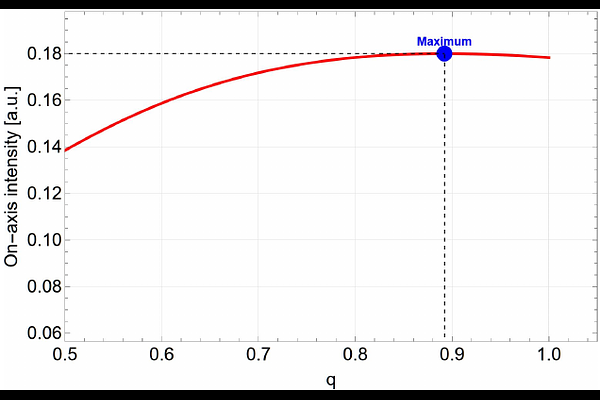
AbstractThe coupling between far-field wavefront error (WFE) and laser pointing jitter is an important source of tilt-to-length (TTL) noise in spaceborne laser interferometric links. We extend the Nijboer--Zernike analytical model for far-field WFE of truncated Gaussian beams by incorporating two practical initial-condition parameters, the beam-waist-to-aperture ratio $q$ and the normalized lateral spot-shift ratio $s_r$, to account for realistic beam truncation and alignment conditions. Based on this model, we analyze the influence of $q$ on far-field WFE in addition to the conventional received-power trade-off, showing that decreasing $q$ from 1 to 0.9 and from 0.9 to 0.8 reduces the mean far-field WFE by approximately 10\% and 14\%, respectively, in Monte Carlo simulations of random initial aberrations. We also derive the direct contribution of lateral spot shift and its coupling with transmitted WFE (constrained to $λ/20$). For the normalized lateral spot-shift ratio $s_r$, a $2~μ\mathrm{m}$ entrance-pupil displacement in a Taiji-like telescope corresponds to $s_r=0.001$ and produces a phase-angle coupling coefficient of about $0.0892~\mathrm{pm/nrad}$, close to the typical far-field TTL requirement $0.1~\mathrm{pm/nrad}$, while the spot-shift--aberration coupling terms are much smaller and can be neglected in practical tolerance estimation. These results provide a theoretical basis for beam-parameter optimization and alignment tolerance design in future space-based gravitational-wave detection missions.