The Epoch of Reionization 21 cm Bispectrum at $z=8.2$ from MWA data II: Smooth Component Filtering

The Epoch of Reionization 21 cm Bispectrum at $z=8.2$ from MWA data II: Smooth Component Filtering
Sukhdeep Singh Gill, Khandakar Md Asif Elahi, Somnath Bharadwaj, Shiv K. Sethi, Akash Kumar Patwa
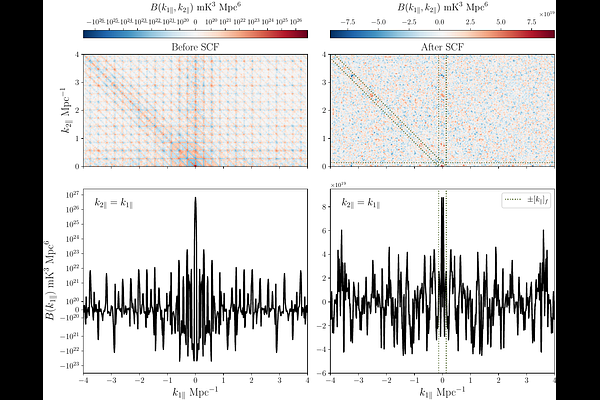
AbstractThe 21 cm bispectrum (BS) offers a powerful probe of the Epoch of Reionization (EoR), but its observational access is severely hindered by dominant astrophysical foregrounds. Considering Murchison Widefield Array (MWA) observations at $154.2~\mathrm{MHz}$ ($z=8.2$), we mitigate the foregrounds with Smooth Component Filtering (SCF) and estimate the 21 cm BS. We validate the pipeline using a simulated 21 cm signal and show that the input BS is recovered for modes $k_{\parallel} \ge [k_\parallel]_f=0.135~{\rm Mpc}^{-1}$. Applied to actual data, the SCF produces substantial foreground suppression, reducing the amplitude of the cylindrical BS $B(k_{1\perp},k_{2\perp},k_{3\perp},k_{1\parallel},k_{2\parallel})$ by $3-4$ orders of magnitude. The artifacts due to the missing frequency channels in the data are also suppressed. The resulting EoR window is significantly cleaner at small $k_{\perp}$. We adopt the region $(k_{1 \perp},k_{2 \perp},k_{3 \perp})\leq 0.026~{\rm Mpc}^{-1}$ and $(k_{1\parallel},k_{2\parallel},k_{3\parallel})>0.135~{\rm Mpc}^{-1}$ to evaluate the 3D spherical BS and constrain the EoR signal. By combining estimates over all triangle shapes, we place the lower and upper limits on the mean cube brightness temperature fluctuations $Δ^3$. The estimates are consistent with statistical fluctuations from system noise. The most stringent lower limit $Δ^3_{\rm LL}=-(1.25\times 10^4)^3~{\rm mK}^3$ and upper limit $Δ^3_{\rm UL}=(1.22\times 10^4)^3~{\rm mK}^3$ are obtained at $k_1=0.281~{\rm Mpc}^{-1}$. Additional observing time will reduce the noise level and enable substantially tighter constraints on the EoR signal.