Complex gas flows in magnetized protoplanetary disks promote the formation of dust traps at low fragmentation velocities

Complex gas flows in magnetized protoplanetary disks promote the formation of dust traps at low fragmentation velocities
Vignesh Vaikundaraman, Joanna Drazkowska, Nerea Gurrutxaga, Xue-Ning Bai
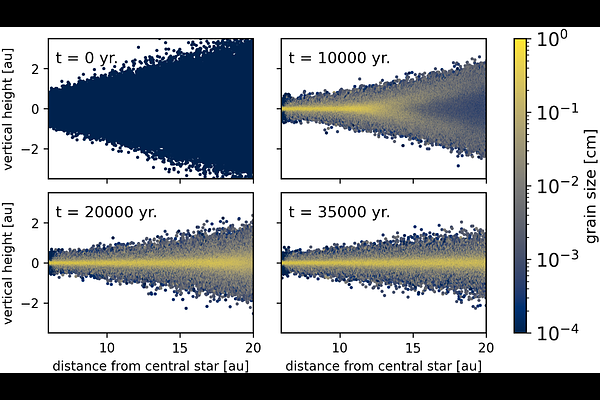
AbstractNon-ideal magnetohydrodynamic simulations of protoplanetary disks show a plethora of complex gas structures, including winds, rings, and gaps. These affect dust transport and help form dust traps, which are essential for planetesimal formation. Although studies have explored the evolution of dust in such systems, they have done so either in 1D or without dust coagulation, and the effect of such systems on dust growth is still an active area of research. This work aims to investigate the effect of a complex gas flow architecture on global dust evolution, including dust growth and transport. We examine the timescales of different processes impacting dust evolution and discuss prospects of forming planetesimals. We post-process gas velocity output from a 2D non-ideal magnetohydrodynamic simulation using a 2D (r-z) Monte Carlo dust coagulation code to perform global simulations of dust growth and evolution. We perform three runs, one with a typical steady-state disk and two with the gas velocity from the MHD simulation, where we vary the fragmentation velocity. Our results show that the advection of small particles by the gas due to strong gas velocities can play an important role in setting the dust size distributions around protoplanetary disks. The gas flow structure has a transition region, and this region acts as a location of a dust pile-up, increasing the pebble-to-gas ratio by a factor of 2.5 when compared to the steady state disk. Lowering the fragmentation velocity improves the stability of the pile-up, but the pebble concentration is not as high. This scenario acts as a way to form a dust trap in a disk without a pressure bump. We discuss the possibilities for planetesimal formation in such a trap.