Chondroitin sulfate degradation bolsters Proteus mirabilis growth and colonization of the catheterized urinary tract

Chondroitin sulfate degradation bolsters Proteus mirabilis growth and colonization of the catheterized urinary tract
Hunt, B. C.; Brix, V.; Deka, N.; Learman, B.; Brauer, A. L.; Shipman, B.; De Nisco, N. J.; Armbruster, C. E.
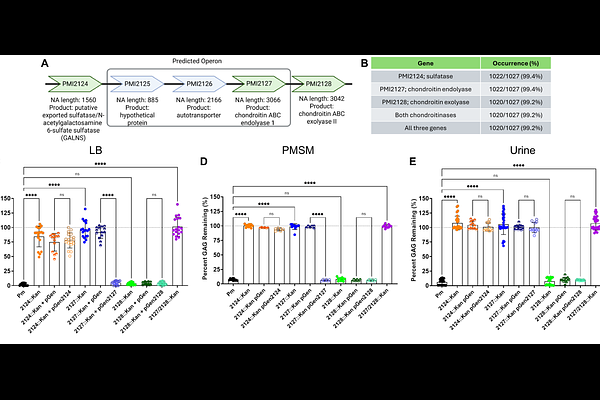
AbstractGlycosaminoglycans (GAGs) are negatively charged polysaccharides composed of repeating disaccharide units and are essential components of the extracellular matrix throughout numerous tissues. The bladder urothelium has a thick protective GAG layer that primarily consists of chondroitin sulfate (CS), heparan sulfate (HS), and hyaluronic acid (HA), and urinary tract pathogens must either degrade or otherwise circumvent this layer to infect the urothelium. In this study, we investigated GAG degradation by Proteus mirabilis, a common and persistent colonizer of the catheterized urinary tract. Almost all P. mirabilis urinary tract isolates harbor a putative chondroitin endolyase (PMI2127), exolyase (PMI2128), and sulfatase (PMI2124). By generating mutant and complemented strains of these genes, we determined that P. mirabilis strain HI4320 degrades multiple forms of CS under numerous culture conditions, including during growth in human urine, and can use CS degradation products as a carbon source. Sulfatase and endolyase activity were required for efficient degradation of all CS types, while the exolyase only contributed to using CS-B or CS-C as carbon source. Interestingly, only endolyase activity contributed to colonization in a murine model of CAUTI, although the colonization defect was even more pronounced when the endolyase and exolyase were both disrupted. The colonization defect was specific to the CAUTI model, likely due to the impact of catheterization on the GAG landscape of the bladder. Limiting CS degradation by P. mirabilis may therefore represent a strategy for reducing risk of ascending infection in catheterized patients.