Alternative splicing shapes sexual dimorphism and erodes following the loss of sex in stick insects

Alternative splicing shapes sexual dimorphism and erodes following the loss of sex in stick insects
Darolti, I.; Labedan, M.; Merel, V.; Schwander, T.
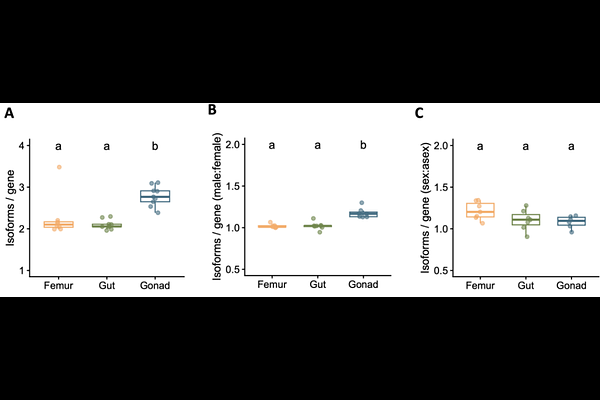
AbstractSexually dimorphic traits emerge from divergent selective pressures acting on males and females and are facilitated by gene regulatory mechanisms. While gene expression differences have been the subject of considerable focus in the evolution of sexual dimorphism, other regulatory processes remain comparatively understudied. One such mechanism is alternative splicing, whereby a single gene can encode multiple distinct transcripts, which can lead to functional diversification of the proteome. Leveraging long-read PacBio Iso-sequencing, we examine patterns of sex differences in gene expression and alternative splicing under different selection regimes. Alternative splicing is widespread in Timema, with the greatest isoform complexity found in the male gonad tissue. We observe similar rates of sex differences in gene expression and splicing, and a core set of genes involved in sexual differentiation and germline development that have conserved differential splicing patterns across the Timema phylogeny. Beyond this, however, differentially spliced genes undergo faster lineage-specific turnover and are subject to greater pleiotropic and purifying constraints than differentially expressed genes. Following the transition from sexual reproduction to asexuality, there is a systematic reduction in isoform diversity and erosion of sex-specific splicing variation. Taken together, our findings suggest a role for sexual selection in maintaining splicing complexity in sexual Timema species.