When and Where: A Model Hippocampal Network Unifies Formation of Time Cells and Place Cells

When and Where: A Model Hippocampal Network Unifies Formation of Time Cells and Place Cells
Yu, Q. S.; Wang, Z.; Balasubramanian, V.
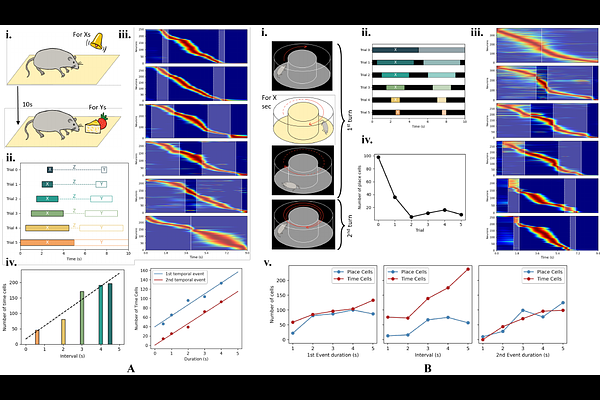
AbstractHippocampal place and time cells encode spatial and temporal aspects of experience. Both have the same neural substrate, but have been modeled as having different functions and mechanistic origins, place cells as continuous attractors, and time cells as leaky integrators. Here, we show that both types emerge from two dynamical regimes of a single recurrent network (RNN) modeling hippocampal CA3 as a predictive autoencoder. The network receives simulated, partially occluded "experience vectors" containing spatial patterns (location-specific activity sampled during environmental traversal) and/or temporal patterns (correlated activity pairs separated by "void" intervals), and is trained to reconstruct missing input. During spatial navigation, the network generates stable attractor-like place fields. But trained on temporally structured inputs, the network produces sequentially broadened fields, recapitulating time cells. By varying spatio-temporal input patterning, we observe hidden units transition smoothly between time cell-like and place cell-like representations. These results suggest a shared origin, but task-driven difference, between place and time cells.