Fabrication of focusing optics for TA-MOONS: Micro-MOONS

Fabrication of focusing optics for TA-MOONS: Micro-MOONS
Ceiwynn Longworth, Megan Delamer, Suvrath Mahadevan, Joe P. Ninan, Kathleen Gehoski, Krushna Jadhav
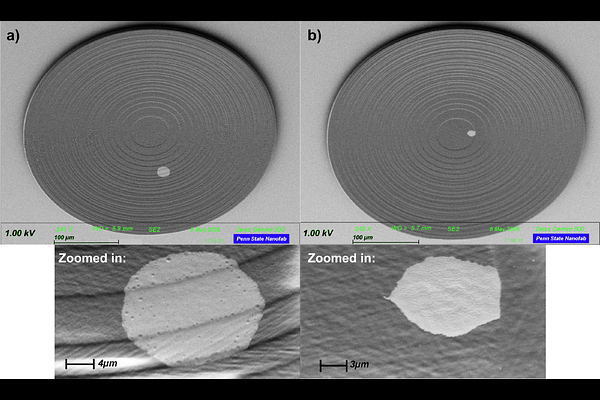
AbstractUnderstanding star and planet formation requires optical to near-infrared spectroscopic observations of a large number of young stellar objects. The TIFR-ARIES Multi-Object Optical to Near-infrared Spectrometer's (TA-MOONS) primary objective is to preform a large spectroscopic survey of young stellar objects across wavelengths of 360 nm to 2.5 microns, with the multiplexed capability of observing up to eight sources simultaneously. Multiplexity is achieved by moving pickup mirrors on robotic arms. One component of this robotic arm system is Micro-MOONS, a micro-optic array, nanofabricated to enable accurate calibration, validation, and positioning of stellar images onto the pickup mirrors. The micro-mirrors of the Micro-MOONS system are spherically concave, fabricated via two-photon polymerization(2PP) in the NanoScribe GT2 system, and are printed on plasma-cleaned silicon substrates using IP-S photoresist, followed by gold coating. 2PP allows for fine, detailed shapes on a sub-micron scale that are otherwise difficult and costly to obtain. The optimization of Micro-MOONS focuses on achieving uniformity, minimizing surface roughness, and preserving the desired radius of curvature to avoid beam obstruction near the pickup mirrors. This work demonstrates the feasibility of integrating advanced custom-printed micro-optics into multi-object spectroscopic instruments, enabling improved calibration and efficiency in large-scale stellar surveys.