Stretch-Evoked Motor Responses in the Brainstem are Modulated by Task Instructions

Stretch-Evoked Motor Responses in the Brainstem are Modulated by Task Instructions
Nikonowicz, R. C.; Reddy, N. A.; Medina, M. C.; Bright, M. G.; Sergi, F.
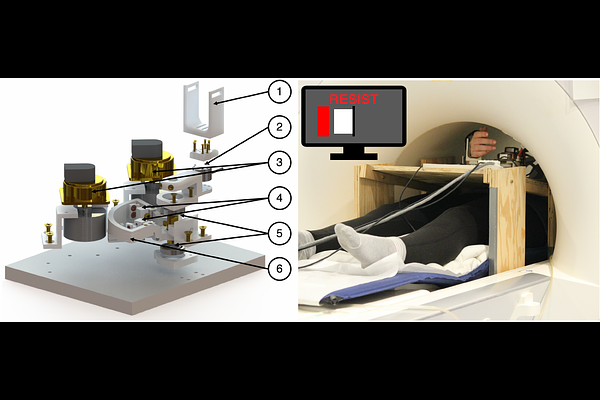
AbstractReliable noninvasive measurement of human brainstem activity during motor control remains challenging due to small anatomical structures and physiological noise, yet it is essential for understanding descending contributions to rapid feedback control. We used brainstem-optimized whole brain functional magnetic resonance imaging (fMRI) to examine whether task-dependent modulation of stretch-evoked motor responses in humans are associated with changes in activation within reticulospinal regions of the human brainstem. A behavioral validation experiment (N=10), in which participants were instructed to resist or yield to brief wrist perturbations, confirmed task-dependent modulation of long-latency responses (LLRs). In a separate imaging cohort (N=26), participants performed the same tasks during fMRI using an MRI-compatible robotic device and a multi-echo acquisition with physiological noise compensation. Imaging analyses revealed greater blood-oxygen-level-dependent signal during Resist compared to Yield while controlling for background contraction and proprioceptive input, with activation distributed bilaterally across the pons and medulla in regions consistent with major reticulospinal nuclei. Laterality analyses demonstrated a rostrocaudal gradient, with relatively ipsilateral-biased activation in the medulla shifting toward more contralateral patterns in the pons. These findings indicate that instruction-dependent modulation of stretch-evoked motor responses is associated with measurable changes in human brainstem activation, providing evidence that reticulospinal regions contribute to task-dependent feedback control.