NAPTIME: A Neural-Process Framework for Rubin Alert Classification

NAPTIME: A Neural-Process Framework for Rubin Alert Classification
Nicholas Earl, Siddharth Chaini, K. Decker French, Jason T. Hinkle, Yashasvi Moon, Margaret Shepherd
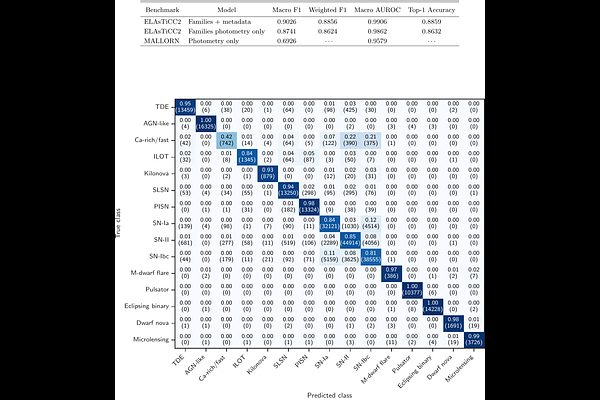
AbstractThe Vera C. Rubin Observatory Legacy Survey of Space and Time will produce a high-volume stream of irregularly sampled multiband alerts for which spectroscopic confirmation will be available only for a small minority of sources. Tidal disruption events are rare phenomena that provide a direct probe of dormant massive black holes, but their light curves can be confused with nuclear variability and other transient subclasses. We present NAPTIME (Neural Astrophysical Photometric Transient Identification and Modeling Engine), a neural-process framework for photometric transient classification under sparse and partial observational context. NAPTIME models irregular multiband light curves directly, combining probabilistic light-curve reconstruction with classification and optional host-galaxy context, as well as photometric-redshift information. We evaluate on two simulated benchmarks: ELAsTiCC2, our primary Rubin-like broad-classification benchmark, and MALLORN, a photometry-only TDE-focused benchmark. On the 15-family ELAsTiCC2 task, the metadata-aware model reaches macro $\mathrm{F1} = 0.903$ and macro $\mathrm{AUROC} = 0.991$, while a matched photometry-only variant reaches 0.874 and 0.986. Viewed as a TDE-versus-rest ranking model, the classifier yields TDE average precision 0.985 with metadata and 0.979 without. Metadata is most valuable in the low-context regime. Using only the earliest 10\% of detected observations, macro F1 is $\sim$0.42 with metadata and $\sim$0.34 without it. On MALLORN, NAPTIME reaches macro $\mathrm{F1} = 0.693$ and macro $\mathrm{AUROC} = 0.958$. These results show that neural processes provide a practical probabilistic framework for Rubin-like transient classification and remain effective for TDE-focused candidate recovery.