CXCR4 coordinates adhesion, migration, and development of human NK cells

CXCR4 coordinates adhesion, migration, and development of human NK cells
Eisman, S.; Grossberg, F.; Koenigsberg, B.; McDermott, D.; van den Haak, F.; Pedroza, L.; Murphy, P.; Mace, E.
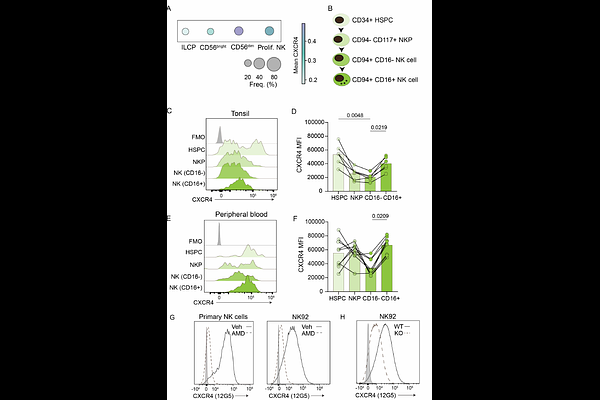
AbstractNatural killer (NK) cells undergo stepwise differentiation from multipotent progenitors within secondary lymphoid tissues. Despite the central importance of the tissue microenvironment in their development, little is known about cell-cell interactions that regulate human NK cell trafficking and maturation. Here, we identify the chemokine receptor CXCR4 and its ligand CXCL12 as regulators of stromal-NK cell interactions required for NK cell maturation. We demonstrate that CXCR4 is expressed throughout human NK cell development in peripheral blood and tonsil, and CXCL12 is enriched in stromal niches containing developing NK cells. Pharmacologic blockade or genetic disruption of CXCR4 resulted in diminished adhesion to integrin ligands and high-resolution imaging demonstrated crosstalk between CXCR4 and integrins, providing a mechanistic basis for chemokine-dependent modulation of adhesion. Further, CXCR4 blockade resulted in altered contact-dependent motility on stromal cells and integrin ligands, with decreased stable stromal engagement and increased cell speed. Consistent with a requirement for these interactions, treatment with the CXCR4 antagonist plerixafor (AMD3100) impaired NK cell generation from CD34+ precursors. Analysis of NK cells from WHIM syndrome patients with CXCR4 gain-of-function mutations treated with plerixafor revealed similar defects in migration and adhesion, supporting the in-vivo relevance CXCR4-dependent regulation of NK cell adhesion and motility.