A COMPASS to the Galaxy: Joint nucleosynthetic yield set comparison and parameter inference in Galactic chemical evolution

A COMPASS to the Galaxy: Joint nucleosynthetic yield set comparison and parameter inference in Galactic chemical evolution
Berkay Günes, Giuseppe Viterbo, Sven Buder, Tobias Buck
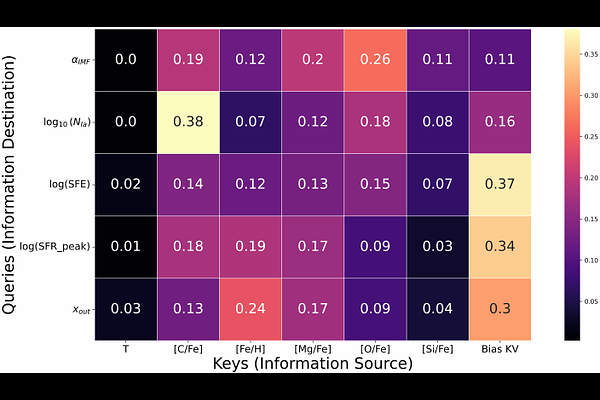
AbstractGalactic Chemical Evolution (GCE) models connect stellar nucleosynthesis to observed abundance patterns, but their interpretation requires simultaneous parameter inference and comparison between competing stellar yield prescriptions. This remains challenging due to intractable likelihoods and growing dataset complexity. Using compass, a novel simulation-based inference framework, we perform, for the first time, amortized joint Bayesian model comparison and parameter inference for GCE models with intractable likelihoods within a unified architecture. Compass employs a conditional score-based diffusion model with a transformer architecture to learn both the posterior and likelihood directly from forward simulations, enabling efficient inference and likelihood-based ranking of competing nucleosynthetic yield sets. In controlled tests, compass identifies the generating yield set and recovers ground-truth parameters with accuracy comparable to existing simulation-based inference (SBI) methods, while reducing computational cost by orders of magnitude. Applied to Milky Way data, the framework favors a hybrid NuGrid + IllustrisTNG yield prescription, confirmed by an independent classifier, and infers an initial mass function slope of $α_{\rm IMF} = -2.65 \pm 0.02$ and a SN$_{\rm Ia}$ normalization of $\log(N_{\rm Ia}) = -2.81 \pm 0.02$, with a systematic spread of $\approx 0.3$ in $α_{\rm IMF}$ between the best-ranked yield sets, consistent with independent constraints. The attention mechanism confirms that the inferred parameters are driven by physically meaningful abundance signatures. By unifying amortized parameter inference, Bayesian model comparison, and interpretability in a single probabilistic framework, compass provides a scalable approach for precision chemical evolution studies with current and forthcoming spectroscopic surveys.