Structural presentation of amyloid β by HLA

Structural presentation of amyloid β by HLA
Erausquin, E.; Dichiara-Rodriguez, M. G.; Oyon-Olea, L.; Lopez-Sagaseta, J.
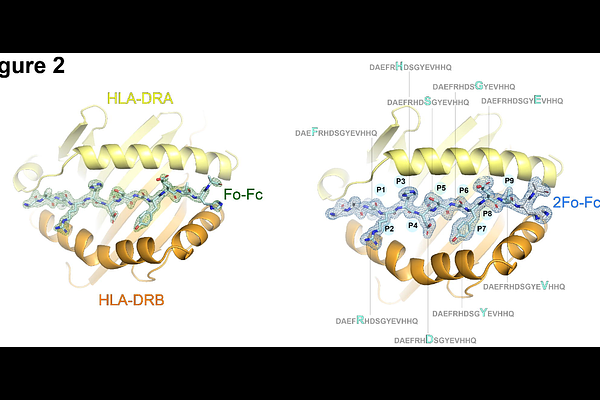
AbstractHLA-DR-restricted T-cell reactivity to amyloid {beta} (A{beta}) has been associated with Alzheimer's disease (AD), but structural evidence for HLA presentation of A{beta}-derived peptides remains elusive. We present the crystal structure of the A{beta}1-15 fragment bound to HLA-DR1, providing, to the best of our knowledge, the first experimental structure of an Alzheimer's A{beta} peptide bound to an HLA molecule. The molecular architecture of this complex defines a peptide:MHC interaction dictated by engagement of A{beta}1-15 peptide central core with further involvement of N- and C-terminal peptide flanks. The structure reveals that DRB1 Arg70, a polymorphic position, directly binds P4 and P5 through polar contacts, providing a rationale for HLA-DRB allelic bias underpinning accommodation of A{beta}1-15. We also describe the A{beta}1-15:HLA-DRB1 surface topology, informing a candidate binding surface for potential T-cell recognition. Collectively, these findings contribute a structural framework for further research in the context of A{beta}-specific CD4+ T-cell autoreactivity in AD.