No evolution in the number density of little red dots from cosmic dawn to cosmic noon

No evolution in the number density of little red dots from cosmic dawn to cosmic noon
Federica Loiacono, Roberto Gilli, Marco Mignoli, Marcella Brusa, Francesco Calura, Marco Chiaberge, Andrea Comastri, Quirino D'Amato, Roberto Decarli, Ivan Delvecchio, Kazushi Iwasawa, Ignas Juodžbalis, Giorgio Lanzuisi, Roberto Maiolino, Stefano Marchesi, Giovanni Mazzolari, Colin Norman, Alessandro Peca, Isabella Prandoni, Matteo Sapori, Matilde Signorini, Paolo Tozzi, Eros Vanzella, Cristian Vignali, Fabio Vito, Gianni Zamorani, Anita Zanella
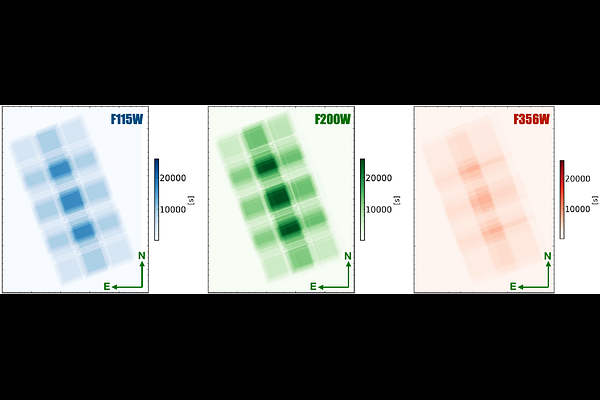
AbstractWe present our search for little red dots (LRDs) in the "J1030 field", a region of the sky around the $z\sim 6.3$ quasar SDSS J1030+0524, observed by the JWST EIGER program. Over 154 point-like sources selected in a JWST-based photometric catalog, we find five broad line emitters (with $FWHM \gtrsim 1000\ \rm km s^{-1}$) that are red ($F200W - F356W > 0$) and are undetected in the X-rays. We use these sources to derive the bolometric luminosity function (LF) of LRDs at $z = 2.4$ and $z = 4.5$. At $z = 2.4$, the space density of LRDs is only a factor of $\sim 2$ lower than that of all pre-JWST active galactic nuclei (AGNs) with bolometric luminosity $L_{\rm bol} \gtrsim 3 \times 10^{44}\ \rm erg\ s^{-1}$. At $z = 4.5$, our estimate is consistent with those derived for LRDs based on larger areas of the sky. A similar behaviour is observed in the black hole mass function. More importantly, we study the number density of LRDs from cosmic dawn to cosmic noon. We find that there is no significant evolution in the abundance of LRDs with $L_{\rm bol} \gtrsim 3 \times 10^{44}\ \rm erg\ s^{-1}$ at $z > 2$. We speculate that the drop at $z < 4$ seen by other studies is due to their sampling of only the bright-end of the LRDs LF. At cosmic noon, the abundance of LRDs is $n = 3.4^{+5.6}_{-2.4} \times 10^{-5}\ \rm Mpc^{-3}$, which is a factor of $\sim 350$ larger than recent model predictions and is comparable with that of X-ray selected AGNs with similar bolometric luminosity. Our result may imply that, if LRDs are the early, rapid stages of supermassive black hole growth, as suggested by some models, then the formation of black hole seeds can be efficient down to epochs as recent as cosmic noon. Alternatively, LRDs may simply be a high-accretion phase in already mature black holes.