Copper stress upregulates oxidative stress response, histidine production and iron acquisition genes in E. coli

Copper stress upregulates oxidative stress response, histidine production and iron acquisition genes in E. coli
Ainelo, H.; Joearu, K.; Ainelo, A.; Ivask, A.
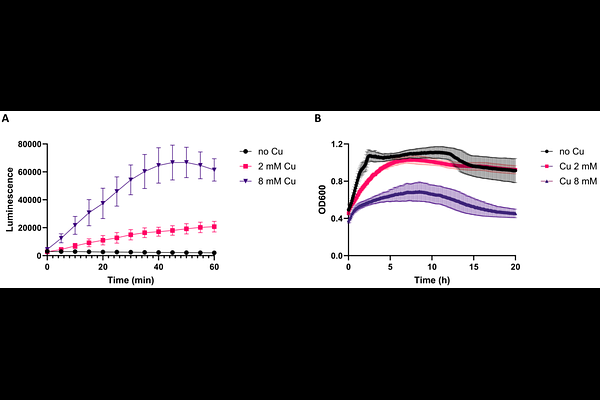
AbstractCopper is widely used as a fast acting antimicrobial, yet the strategies that allow bacteria to survive copper stress remain incompletely understood. Here, we characterize the transcriptional responses of Escherichia coli MG1655 to excess ionic copper using RNA sequencing and a genome wide GFP based promoter library. We applied 2 mM copper, which slows growth, and 8 mM copper, a near lethal concentration. RNA seq revealed extensive transcriptome remodeling, with 487 genes upregulated at 2 mM and 364 at 8 mM. Both concentrations strongly induced canonical copper responsive systems, oxidative stress defenses, histidine biosynthesis, and multiple iron acquisition pathways - including enterobactin biosynthesis and transport - despite external iron failing to reduce copper toxicity. At 2 mM copper, additional pathways were activated, including heat shock and protein folding functions as well as lipid A, methionine and arginine biosynthesis. Copper exposure also repressed large gene sets: 486 genes at 2 mM, enriched for biofilm formation and pH elevation, and 217 genes at 8 mM, enriched for anaerobic metabolism. In contrast to the robust RNA seq results, we investigated the Horizon Discovery E. coli genome-wide GFP based promoter library as an alternative screening tool. However, in our experiments it showed low signal to noise ratios, limiting its suitability for large scale gene expression screening.