Full Dynamical Model (SOCOL:14C-Ex) of 14C Atmospheric Production and Transport in Application to Miyake Events

Full Dynamical Model (SOCOL:14C-Ex) of 14C Atmospheric Production and Transport in Application to Miyake Events
Kseniia Golubenko, Ilya Usoskin, Edouard Bard, Sergey Koldobskiy, Eugene Rozanov
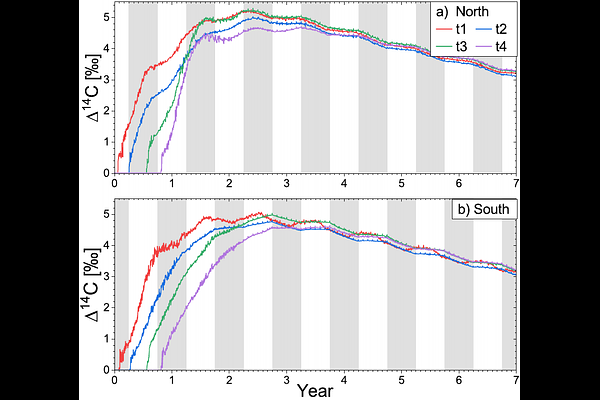
AbstractExtreme solar particle events (ESPEs) are caused by rare, enormously strong solar eruptions and can produce globally detectable spikes in tree-ring radiocarbon 14C, known as Miyake events, which serve as precise chronological tie-points and indicators of extreme solar activity. After production, radiocarbon is subjected to the complex carbon cycle, including large-scale atmospheric transport, which is crucially important for fast and strong Miyake events with highly inhomogeneous 14C production. A new 3D dynamical model, SOCOL:14C-Ex, of the radiocarbon atmospheric production and transport is presented here, which can model fast changes in the 14C atmospheric concentrations with high temporal and spatial resolution. Precise response curves of $Δ^{14}$C to a reference ESPE (100xGLE#69) were computed for various event dates. They can be directly applied to analyse Miyake events under different conditions. Seven strong events over the past 14 millennia (AD 993, AD 774, 664 BC, 5260 BC, 5411 BC, 7177 BC, and 12351 BC) were analysed by fitting the reference curves to the available annual D14C data, identifying the most probable values and confidence intervals of their parameters -- strength, event's date and background level. By applying corrections for the geomagnetic and atmospheric (CO2) factors, the strengths of the corresponding ESPEs were assessed. The strongest ESPE is confirmed to be that of 12351 BC, while that of AD 774 remains the strongest event during the Holocene. To conclude, a new tool, based on the radiocarbon atmospheric transport model SOCOL:14C-Ex, is presented to analyse fast changes in the $^{14}$C production.