Clamp the LAMP: a photoelectrochemical platform for KRAS mutation detection via wild-type blocking

Clamp the LAMP: a photoelectrochemical platform for KRAS mutation detection via wild-type blocking
Strmiskova, J.; Valverde, A.; Moranova, L.; Arnouts, J.; Zavadil-Kokas, F.; Koljenovic, S.; Zwaenepoel, K.; Vandamme, T.; Bartosik, M.; De Wael, K.
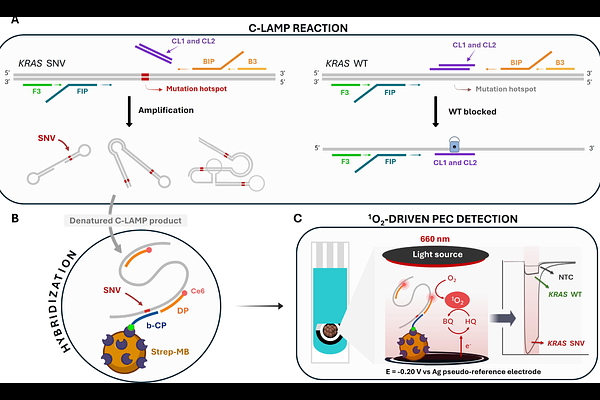
AbstractKRAS mutations are among the most prevalent oncogenic alterations in colorectal, lung, and pancreatic cancer, yet their detection remains analytically challenging in the presence of an overwhelming wild-type (WT) background. Here, we report a photoelectrochemical (PEC) genotyping platform that integrates clamp-inhibited loop-mediated isothermal amplification (C-LAMP) with enzyme-free singlet oxygen (1O2)-driven PEC transduction for mutation-selective KRAS detection. Locked nucleic acid (LNA) clamp probes selectively suppress WT amplification during isothermal amplification, enriching mutant alleles and enabling single-nucleotide variant (SNV) discrimination with high selectivity. Amplified products are magnetically captured and transduced into photocurrent via visible-light-induced 1O2 redox cycling, eliminating enzymatic reporters and reducing background interference. The C-LAMP/PEC platform achieves a limit of detection of 35 copies L-1 (58 aM) and a minimum detectable variant allele frequency (VAF) of 4.8% in heterogeneous mutant/WT genomic DNA mixtures. Analytical performance was validated in cancer cell lines and in patient-derived fresh frozen tissues, showing complete concordance with Nanopore sequencing and droplet digital PCR (ddPCR) within the evaluated cohort (n = 16). This work introduces a robust and modular PEC biosensing strategy that combines molecular WT suppession with enzyme-free photoelectrochemistry, offering an economically competitive and instrumentation-simplified approach for clinically relevant KRAS mutation analysis toward decentralized testing.